

Updated October 10, 2026. Diana Taurasi's WNBA career ran through 20 played seasons with the Phoenix Mercury. Drafted first overall in 2004, she helped the club win titles in 2007, 2009 and 2014 and ended her regular-season career with 10,646 points. She retired in February 2025 after last playing in 2024. Her Phoenix years are also part of a larger basketball story that includes three UConn titles and six Olympic gold medals, but those belong to separate competitions.
What is Diana Taurasi's WNBA career record?
Taurasi was a one-club WNBA player: Phoenix drafted her, and Phoenix remained her league home through her final game. The WNBA's Mercury page lists her years as 2004–2024. That calendar span can look like 21 seasons at first glance, but she did not play a WNBA season in 2015. The correct count is 20 seasons played. A fan comparing her with other long-tenured players should use seasons actually played rather than subtracting the start year from the end year.
Her résumé has two kinds of answers. Points, three-pointers and assists describe what she recorded in regular-season games. Championships and Finals MVPs describe what happened in postseason competition. The categories meet in one career but should not be added together as though they were the same statistic. Search pages often compress them into a row of numbers; the meaning behind each number is more useful.
Her final regular-season numbers
The official WNBA regular-season all-time table lists Taurasi with 10,646 points, 1,447 made three-pointers and 2,394 assists in 565 games. She remained first on the league's career points list at the October 2026 check. The WNBA player biography also gives a rounded career scoring average of 18.8 points per game. These numbers are her finished WNBA regular-season record, not an estimate from an old news story or a total that includes Olympic games.
Different WNBA articles about Taurasi show different totals because they were written at different career moments. The league celebrated her when she became the points leader in 2017 and again when she crossed 10,000 in 2023; naturally, neither midcareer story could show the final 10,646. A reader should ask when a page was published and which games its statistical filter includes. The site's WNBA scores page follows current games, while this retrospective fixes Taurasi's completed career line.
Her assist total is a reminder that the points record did not come from a player who only finished possessions. It reflects passes that led to teammates' baskets across changing Phoenix lineups. Similarly, a three-point make is a shot type, not a separate basket added on top of her points total. The three-pointers already contributed to those 10,646 points. Keeping the columns straight is especially helpful when fans compare her with later players in a league where schedules and styles have changed.
The awards behind the headline
The league's official player biography credits Taurasi with three Mercury championships, the 2009 regular-season Most Valuable Player award, Finals MVP awards in 2009 and 2014, and 11 All-Star selections. A team wins a title; an individual receives MVP. The fact that she won two Finals MVP trophies, not three, is significant because Cappie Pondexter won the 2007 Finals MVP when Phoenix claimed its first championship.
Each award points to a different question. The 2009 season MVP evaluates work across the league schedule. A Finals MVP evaluates the title series, which may be only three or five games. The championships measure whether Phoenix won its last postseason series. None of those awards alone sums up every contribution by Taurasi, Pondexter, Penny Taylor, Brittney Griner and other teammates in their respective title years. Reading the awards with their seasons attached gives fans a fairer picture than treating three rings as three identical one-player performances.
There is a practical reason to keep the historical record separate from today's WNBA pages. The Mercury's present roster, opponents and schedule change each year, but Taurasi's played seasons and title years do not. Fans looking for the current club can use the Phoenix Mercury schedule; those present-day games do not alter her finished 2004–24 player record.
How did UConn and the 2004 draft start her Phoenix career?
Before Phoenix fans knew Taurasi as the franchise's No. 3, college basketball fans had seen her lead Connecticut through three consecutive NCAA championship seasons. That background explains the expectation around her 2004 draft selection, but it is not a substitute for what she accomplished in the WNBA. She won a rookie award in her first professional season and waited three more years for the first Phoenix title. The route from college star to champion was built through draft decisions, developing teammates and a succession of playoff series.
Three college titles, a No. 1 pick and a rookie award
UConn's official player biography says Taurasi helped guide the Huskies to titles in 2002, 2003 and 2004. Her senior year made her a two-time national player of the year. That sustained college success was a powerful signal to pro scouts: she had scored, passed and led in high-profile games against different opponents. It did not mean professional competition would be identical, and the NCAA trophies do not count as WNBA championships.
At the 2004 WNBA Draft, the Mercury made her the first overall selection. The league timeline dates that selection to April 17. Taurasi then averaged 17.0 points, 4.4 rebounds and 3.9 assists in her rookie campaign, according to a WNBA draft retrospective. She was immediately more than a spot-up scorer: the assist figure reflects regular involvement in Phoenix's offense. Her 2004 campaign earned both Rookie of the Year and an All-WNBA First Team place on the official awards list.
Those two awards tell complementary stories. Rookie of the Year compares a new player with her first-year peers; All-WNBA First Team recognizes performance among all league players. Taurasi had met a demanding first-year standard, but a player award does not automatically make a rebuilding team a champion. Phoenix's title story had to develop beyond the draft itself.
Phoenix's 2007 breakthrough
The Mercury reached the 2007 Finals against the Detroit Shock. Phoenix fell behind 2–1 before winning Game 4 by a single point, then closed the series with a 108–92 road victory in Game 5. The league's 2007 playoff record identifies this as the franchise's first championship. That road finish matters: the Mercury did not merely defend home court through the last game; they beat the reigning champion where the Shock expected to celebrate.
Cappie Pondexter won that Finals MVP with averages of 22.0 points and 5.6 assists in the series. Taurasi and Penny Taylor were other central members of the Phoenix core. It is fair to describe Taurasi as a 2007 WNBA champion; it would be inaccurate to call her the 2007 Finals MVP. The distinction protects the record of a teammate whose performance the league specifically honored.
Looking back from later title years, the 2007 win also marks a change in what Taurasi's Mercury career meant. Her rookie production had established an individual standard. Winning an elimination game and then the deciding Finals game showed that a Phoenix group could turn talent into a postseason result. One championship did not settle the next season's outcome, but it gave the franchise a foundation for another run.
Why 2009 and 2014 were different title runs
Phoenix's second championship came against the Indiana Fever in 2009. A WNBA playoff recap starts with a 120–116 overtime Mercury win, then shows Indiana moving ahead 2–1 in the series. Phoenix recovered with a road Game 4 win and a 94–86 home win in Game 5. Taurasi scored 26 in that clincher and was named Finals MVP. She had already been awarded the regular-season MVP for her league-wide performance, including a 20.4 points-per-game scoring lead. The two MVPs refer to different sets of games.
The 2014 Mercury were more dominant across the regular season. The league's season review records a 29–5 mark, Brittney Griner's major defensive role and Penny Taylor's continued importance. Phoenix swept Chicago 3–0 in the Finals. Game 3 still required a closing effort: Taurasi scored 14 of her 24 points in the fourth quarter and finished a late three-point play to break an 82–82 tie. She received her second Finals MVP.
That sequence leaves three distinct championship memories: 2007's first breakthrough against Detroit, a 2009 comeback against Indiana, and a 2014 sweep after a 29-win season. If you want to follow the current competition rather than revisit those past series, the site's WNBA playoff tracker is the live resource. This article keeps the historical opponents, title years and awards attached to the player and teams that actually earned them.
How did Taurasi become the WNBA scoring leader?
A final career number can hide the years it took to build. Taurasi's path to 10,646 points included an all-time scoring takeover in 2017 and the first 10,000-point career in WNBA history in 2023. Both were news when they happened; neither was the endpoint. She still played after crossing 10,000, adding 646 more regular-season points before retirement. The record therefore has a chronology, and old milestone articles should be read as snapshots of that chronology.
Her three-point mark also developed separately from her total points. A made three contributes three points to the scoring total, so the totals are related, but the leaderboard for makes asks a different question from the points leaderboard. Fans comparing records should check which category a source names before repeating a figure.
The 2017 scoring and three-point milestones
In early June 2017, Taurasi became the WNBA's career three-point leader. The league's photo report from Chicago identifies her 907th made three as the shot that moved her past Katie Smith. It was a fitting record for a guard whose range had shaped Phoenix possessions for more than a decade. A defense had to respect the possibility of a deep attempt, and that threat could open another action even when Taurasi passed instead of shooting.
On June 18, 2017, she reached her 7,489th career point and moved ahead of Tina Thompson's 7,488. The WNBA's account describes a drive and layup for the record basket. It is a useful correction to a narrow image of her as only a long-range shooter: a two-point finish produced the scoring milestone. Taurasi had already scored far more than any one spectacular game could provide; she had accumulated the mark across her Phoenix seasons.
The records happened in the same month but in different games, and they displaced different players. Katie Smith held the three-point mark; Tina Thompson held the points mark. Taurasi did not reach 10,000 in 2017. A quick chronology prevents those facts from being collapsed into one night or one previous record holder.
From 10,000 points to her final line
Six years later, on August 3, 2023, Phoenix beat Atlanta 91–71 and Taurasi scored 42. The WNBA's official recap calls her the first league player to reach 10,000 career points. The 42-point performance gave the night its drama, yet the round-number milestone depended on all the ordinary games before it. Every season in which she returned to create shots and get to the line contributed to that threshold.
After her final 2024 season, the league's regular-season all-time table settled at 10,646 points over 565 games. Her 1,447 made threes show how much perimeter scoring fed that total. Her 2,394 assists show a complementary skill: setting up teammates' shots. Taurasi was not the all-time assists leader—Sue Bird held that distinction—but the passing number belongs alongside the shooting when a fan asks what sort of offensive player she was.
These totals should not be silently merged with playoff games or Olympic contests. A WNBA postseason basket belongs to a different statistical filter, even if it was more memorable than a regular-season score. That is why the official all-time table remains the reference for her 10,646 figure. It also explains why comparing a current player's in-progress total with Taurasi's finished line requires a date. As of this October 2026 check, Taurasi still led the regular-season career points table; later seasons could change the ranking without changing what she scored.
What does Taurasi's retirement legacy include?
Taurasi's final WNBA season was 2024, but the end of her playing career and the largest honors that followed arrived on different dates. She announced retirement in February 2025. Phoenix raised her No. 3 in August 2026. Her sixth Olympic gold had come at the Paris Games in 2024. Putting those events in order avoids a common mistake: calling the 2025 announcement a 2025 playing season or treating the 2026 ceremony as another on-court achievement.
They also show that three organizations valued different aspects of the same career. USA Basketball measured a long national-team contribution. The WNBA marked her record-setting league play. The Mercury celebrated a player who had worn one club's uniform through generations of teammates and fans. None of those honors needs to be collapsed into one vague “greatest ever” label to be meaningful.
Six Olympic golds and the 2025 announcement
Taurasi won Olympic basketball gold with the United States in 2004, 2008, 2012, 2016, 2020 and 2024, as listed in the WNBA's player biography and USA Basketball records. The Tokyo 2020 edition took place in 2021 after postponement; the official Olympic year remains 2020. USA Basketball described the Paris title as making her the first basketball player with six Olympic gold medals.
The medal count is not an extension of her Mercury championships. National teams include other elite WNBA players, play under international rules and have their own tournament path. Taurasi's repeated selection over a two-decade span says a great deal about trust and continuity within the U.S. program, while each gold remains a team achievement. It is possible to admire the six medals without using them as a substitute for explaining her Phoenix playoff record.
On February 25, 2025, Taurasi announced her retirement after 20 WNBA seasons. The league's commissioner statement recognized the scoring and three-point records she was leaving behind. She had last played for Phoenix in 2024, so her statistics were complete when the announcement became public. That gap between a final game and a formal retirement decision is common in sports and does not add another playing season to a career line.
Phoenix retires No. 3 and fans debate the GOAT
The Mercury honored Taurasi on August 16, 2026 by retiring her No. 3 and inducting her into the franchise's Ring of Honor. The WNBA game account ties the event to a Phoenix home date against Portland, and the current Mercury team page lists No. 3 among its retired numbers. Raising a jersey does not change a box score. It tells fans that the club chose to keep that number attached to Taurasi's 2004–24 story.
Phoenix's celebration extended outside the arena. The ceremony report hosted by the WNBA describes a nearby street named 10646 Taurasi Way, using her final regular-season points total. The detail joins a city landmark to the figure on the league's statistics table. It also explains why a retired player's name remained prominent in Phoenix well after her last season.
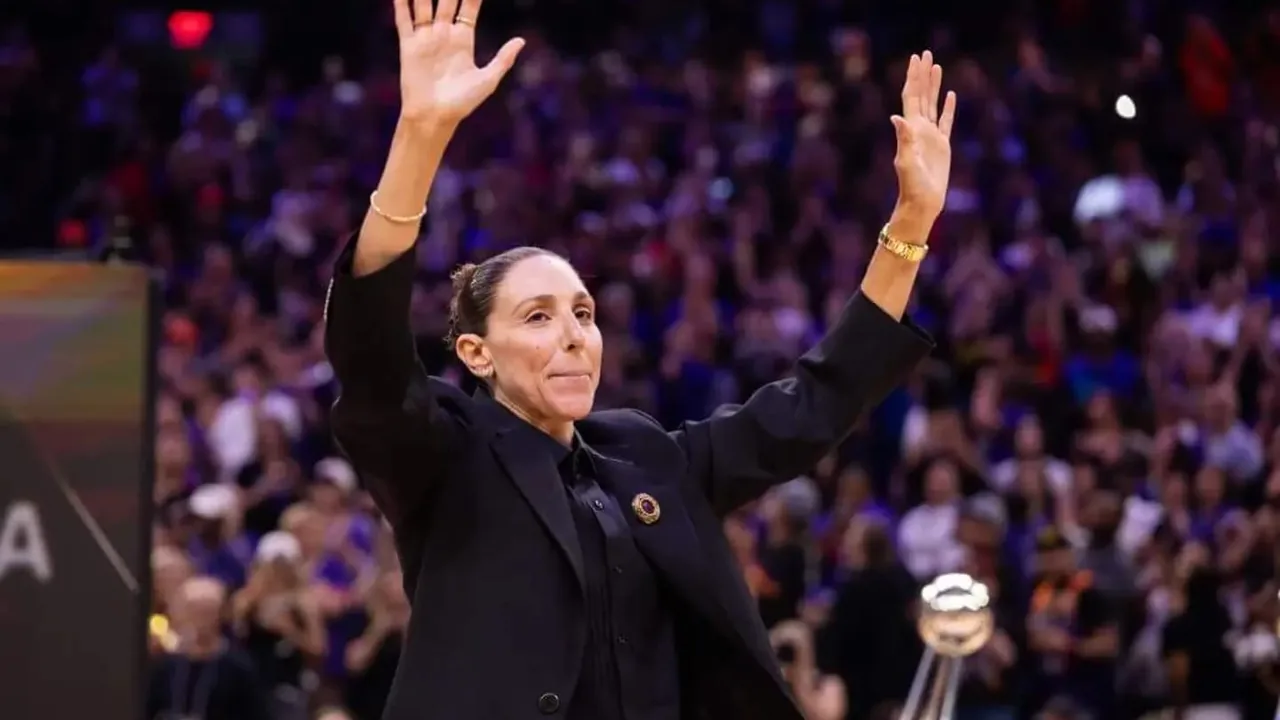
A different recognition arrived before she retired. During its 25th-season celebration in 2021, the WNBA asked fans to choose a “GOAT” from its W25 group, and Taurasi won that fan vote. It captures real admiration, but a poll is not a universal ranking formula. Fans can reasonably weigh peak dominance, defense, championships, longevity and cultural influence differently when comparing Taurasi with other great players. The precise claim is that she won the league's 2021 fan vote, alongside a career of independently verifiable records and titles.
The essential answers are clear: three Mercury WNBA titles, 10,646 regular-season points, six Olympic golds, a February 2025 retirement announcement and a 2026 Phoenix No. 3 tribute. Each belongs to its own date and competition. For more historical explanations beyond this one player's career, the site's WNBA articles archive offers further guides; for present-day Phoenix games, use the club schedule linked earlier. Taurasi's finished career can be read without mistaking today's scores for her records or a fan debate for an official statistical category.
Sign in with Google to join the discussion.