
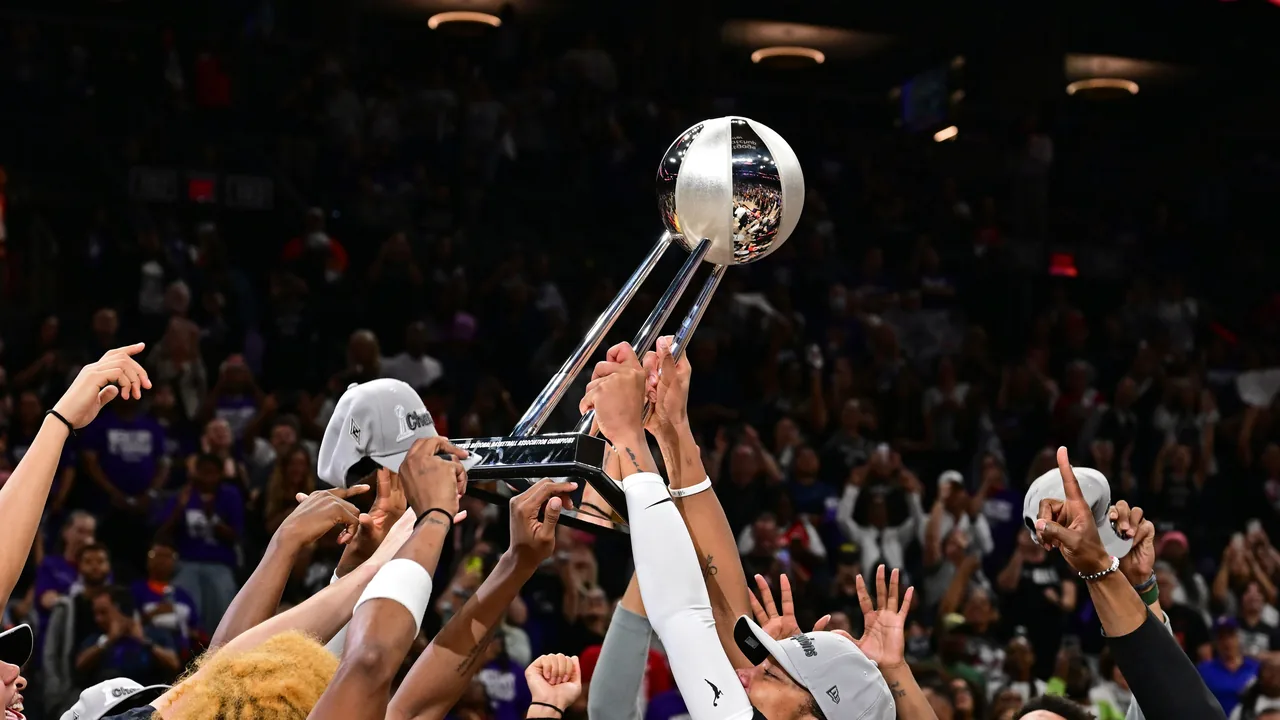
The Las Vegas Aces won the 2025 WNBA Finals, sweeping the Phoenix Mercury 4-0. Las Vegas completed the title run on October 10 with a 97-86 victory in Phoenix, becoming champion in the league's first best-of-seven Finals. A'ja Wilson earned Finals MVP after averaging 28.5 points and 11.8 rebounds, then delivered 31 points and nine rebounds in the clincher.
The sweep was decisive without being uniformly easy. Game 1 stayed unsettled until Phoenix missed a potential tying three, and Game 3 ended on Wilson's turnaround jumper with 0.3 seconds left. Game 2 and Game 4 showed the other side of the matchup: Las Vegas could create separation with its depth, shooting and pressure at the foul line. The Aces scored at least 89 points in every game and finished the series averaging 91.8.
This recap lists every result, explains how both finalists reached the championship round, and identifies the possessions that decided each game. It also separates the four games that were actually played from the three dates that had been reserved only if necessary. For the current championship calendar rather than the completed 2025 results, use our 2026 WNBA Finals schedule guide.
2025 WNBA Finals results at a glance
| Game | Date | Matchup | Result | Series | Key performance |
|---|---|---|---|---|---|
| 1 | Oct. 3 | Phoenix at Las Vegas | Aces 89, Mercury 86 | Las Vegas 1-0 | Wilson and Dana Evans: 21 points each |
| 2 | Oct. 5 | Phoenix at Las Vegas | Aces 91, Mercury 78 | Las Vegas 2-0 | Jackie Young: 32 points |
| 3 | Oct. 8 | Las Vegas at Phoenix | Aces 90, Mercury 88 | Las Vegas 3-0 | Wilson: 34 points, winning shot |
| 4 | Oct. 10 | Las Vegas at Phoenix | Aces 97, Mercury 86 | Las Vegas wins 4-0 | Wilson: 31 points, nine rebounds |
The result pattern tells a useful story. Phoenix had a possession to tie Game 1 and recovered from 17 points down in the fourth quarter of Game 3, so the two odd-numbered games were decided by five total points. Las Vegas controlled the even-numbered games more clearly, winning Game 2 by 13 and the clincher by 11. The Aces won both home games, then removed any chance for the series to return to Nevada by winning twice in Phoenix.
Only four rows belong in a results table. October 12, 15 and 17 had been reserved for Games 5, 6 and 7, but every one was marked “if necessary” when the league released the schedule. A best-of-seven ends as soon as one team reaches four wins. Las Vegas did that in four games, so the remaining dates were never played; they were not postponed or canceled results.
The locations followed the opening portion of the new 2-2-1-1-1 format: two games at the higher seed, then two at the lower seed. Had Phoenix extended the series, Game 5 would have returned to Las Vegas. Fans looking for games that are actually upcoming should use the full WNBA schedule rather than a closed historical bracket.
How Las Vegas and Phoenix reached the Finals
Las Vegas arrived as the No. 2 seed with a 30-14 record, but that finish hid a dramatic turnaround. The Aces were 14-14 through 28 games before winning their final 16 regular-season contests. That surge secured home-court advantage in the Finals and restored a contender that had looked vulnerable in midseason. The postseason was less direct: Seattle pushed Las Vegas to a deciding Game 3 in the first round, and sixth-seeded Indiana extended the semifinal to Game 5 before the Aces advanced 3-2.
Phoenix followed a different route. A heavily rebuilt Mercury roster finished 27-17 as the No. 4 seed, then eliminated both teams from the previous year's Finals. Phoenix defeated defending champion New York 2-1 in the first round and removed top-seeded Minnesota 3-1 in the semifinal. Alyssa Thomas gave the Mercury an organizing force as a passer, scorer and rebounder, while Kahleah Copper, Satou Sabally and returning veteran DeWanna Bonner supplied several ways to attack a defense.
The pre-series numbers suggested a true strength-against-strength matchup. Through eight playoff games, Las Vegas led the postseason in offensive rating at 108.9, points per game at 87.0, and effective field-goal percentage at 53.9%. Through seven games, Phoenix owned the best defensive rating at 92.2 and allowed the fewest points per game at 75.9. This was not an obvious mismatch on paper: the league's hottest offense was meeting the defense that had just eliminated the No. 1 seed.
The regular-season meetings pointed toward close games as well. Las Vegas won the series 3-1, but three of the four were decided by six points or fewer. The outlier was an 83-61 Aces win in August, after Las Vegas had begun its late-season climb. That combination—three tight meetings and one decisive Aces win—foreshadowed the Finals better than either team's seed alone.
The route also explains why Las Vegas's sweep deserves more than a shorthand reading. The Aces had already survived two elimination-length series, while Phoenix had proved it could win on the road and upset elite opposition. For a breakdown of how today's rounds and home patterns work, see our current WNBA playoff format. In 2025, both finalists had faced genuine pressure before Game 1 began.
Game 1: Aces 89, Mercury 86
Game 1 established the tension that the final series score can hide. Phoenix opened a 10-2 lead, Las Vegas answered, and neither team ever moved ahead by more than nine. The night produced 12 lead changes and nine ties. Kahleah Copper was the early problem for the Aces, scoring 19 of her 21 points before halftime and making five first-half threes.
Las Vegas changed the game with depth. Dana Evans scored 21 off the bench and Jewell Loyd added 18, helping the Aces reserves outscore Phoenix's bench 41-16. Evans matched A'ja Wilson for the team scoring lead, an important reminder that the Aces did not have to ask their MVP to manufacture every basket. Wilson still supplied 21 points and 10 rebounds, while Chelsea Gray created 10 assists.
Phoenix's stars kept the margin narrow. Satou Sabally scored 19, and Alyssa Thomas nearly posted a triple-double with 15 points, 10 rebounds and nine assists. The closing minute ultimately separated the teams. With Phoenix behind by one and 24.6 seconds left, Thomas went to the free-throw line but missed both attempts. Jackie Young then drew a foul and made two free throws with 13.5 seconds remaining.
The Mercury still had one last chance. Sabally launched a long three with about two seconds left, but it did not fall. Las Vegas escaped 89-86 rather than winning comfortably. The pivotal difference was not one spectacular run; it was the Aces finding more usable scoring beyond their starters and executing the final free throws after Phoenix had left two points available. That combination gave Las Vegas a 1-0 lead and placed immediate pressure on the Mercury to earn a road split in Game 2.
Game 2: Aces 91, Mercury 78
Phoenix again started quickly, scoring the first seven points and reaching 27 by the end of the first quarter. Las Vegas did not chase the game with one rushed burst. The Aces tightened their defense, held the Mercury to only 24 points across the second and third quarters combined, and built a 76-51 lead after three. By then, the competitive question had shifted from who would win to whether Phoenix could make the final score respectable.
Jackie Young created the separation. She scored a WNBA Finals-record 21 points in the third quarter and finished with 32, tying her career playoff high. The qualifier matters: 21 set the record for one quarter of a Finals game, while the broader postseason single-quarter record was 22. Young repeatedly turned a stable Aces advantage into an impossible chase, scoring from the perimeter and attacking before Phoenix could reset its defense.
A'ja Wilson had already placed Las Vegas in control. She scored 20 of her 28 points before halftime and collected 14 rebounds. Chelsea Gray added a 10-point, 10-assist double-double, giving the Aces a second organizer whenever Phoenix tried to load defenders toward Wilson. Young and Wilson combined for 60 points, then the second-highest total by a pair of teammates in a WNBA Finals game.
Kahleah Copper led Phoenix with 23 points and Satou Sabally scored 22, but the Mercury could not sustain their first-quarter efficiency. Alyssa Thomas finished with 10 points while managing foul trouble. Phoenix reduced a peak 22-point deficit during the fourth, yet the 91-78 result remained the series' clearest Aces win to that point. Las Vegas carried a 2-0 lead to Arizona because its defense survived the opening punch and Young produced the defining quarter.
Game 3: Aces 90, Mercury 88
For three quarters, Game 3 looked like another display of Las Vegas's offensive range. The Aces used a 17-0 first-quarter run to move ahead 21-8, and Jewell Loyd made four threes in less than two minutes off the bench. Phoenix answered with 13 straight points, but Las Vegas still led 55-43 at halftime after shooting 9-for-16 from beyond the arc. The margin grew to 76-59 entering the fourth.
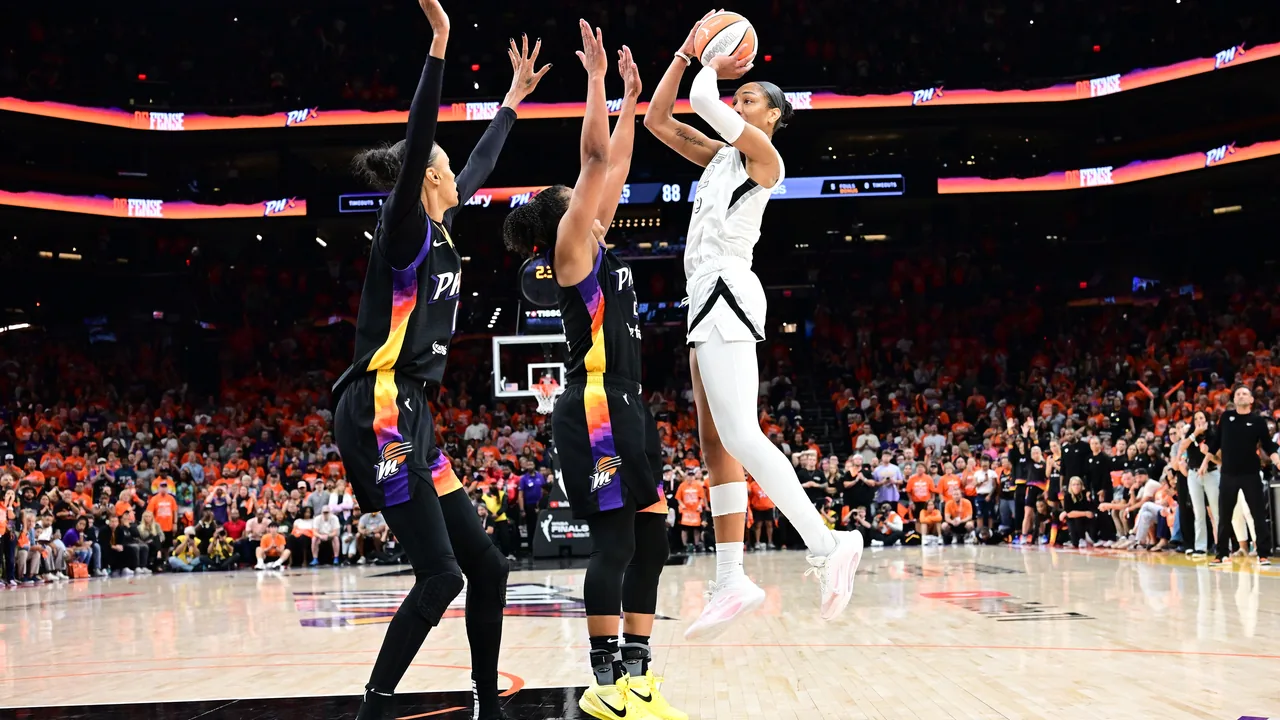
Phoenix transformed the game in the final period. Kahleah Copper scored 11 of her 17 points in the fourth and hit a three that cut the deficit to 84-83 with 3:06 left. DeWanna Bonner, who led the Mercury with 25, tied the score at 86 on a three and then made two free throws with 1:01 remaining to make it 88-88. Alyssa Thomas finished one assist short of a triple-double with 14 points and 12 rebounds.
That comeback carried a painful complication. Satou Sabally, who had scored 24, became tangled with Jackie Young and fell into Kierstan Bell with 4:26 remaining. She hit her head, remained down for several minutes and was helped off. The injury removed one of Phoenix's primary scorers from the final possessions and ultimately kept her out of Game 4 under concussion protocol.
The deciding play belonged to Wilson. With the game tied, she caught on the left side, worked into a turnaround and released over Thomas and Bonner. The jumper fell with 0.3 seconds showing. Bonner's rushed final try missed, completing a 90-88 Aces win. Wilson finished with 34 points, 14 rebounds, four assists and three blocks; Young added 21.
Calling the shot “at the buzzer” would blur an important detail: Phoenix did receive a final fraction-of-a-second possession. The sharper conclusion is that Wilson delivered the last made basket after the Mercury had erased a 17-point fourth-quarter deficit. Las Vegas left Phoenix with a 3-0 lead, but Game 3 gave the series its defining image and strongest evidence that the sweep was not four routine wins.
Game 4: Aces 97, Mercury 86
Las Vegas removed most of the suspense from Game 4 before halftime. The Aces never trailed, shot 55% in a 30-point first quarter and led 30-21. Early in the second, Jewell Loyd, Chelsea Gray and Dana Evans made three consecutive threes to stretch the advantage to 19. Las Vegas carried a 54-38 lead into the break, its ball movement and shooting forcing Phoenix to defend more creators than an injured rotation could comfortably cover.
Phoenix was without Satou Sabally, who had entered concussion protocol after the Game 3 collision. The Mercury then saw Alyssa Thomas leave before halftime after a hard hit to her right shoulder. Thomas returned for the second half and ultimately posted 17 points, 12 rebounds and 10 assists, but the physical toll narrowed an already difficult margin. Coach Nate Tibbetts was ejected in the third quarter after receiving two technical fouls.
The Mercury still generated a last meaningful push. Las Vegas led 76-62 after three, then Phoenix scored eight straight to cut the gap to six with 7:56 remaining. Gray answered the pressure by making two of her four threes in the fourth quarter, and Phoenix came no closer. Kahleah Copper carried the Mercury offense with 30 points on 12-for-22 shooting, but the Aces maintained multiple sources of scoring.
A'ja Wilson finished with 31 points and nine rebounds. Her 7-for-21 field-goal line was inefficient by her standard, yet it also showed how she controlled the game in other ways: she earned 19 free throws and made 17. Gray and Jackie Young scored 18 apiece, and five Aces reached double figures. The clincher was not dependent on one hot shooter or one late break.
The final score was 97-86—an important correction to erroneous snippets that have circulated with a different number. Las Vegas averaged more than 90 points across the four games and ended the inaugural best-of-seven Finals at the first possible opportunity. The Aces' first-half creation, Wilson's foul pressure and Gray's response to the fourth-quarter run turned a potential extension of the series into the franchise's third championship in four seasons.
Why A'ja Wilson won 2025 WNBA Finals MVP
Wilson's Finals MVP case began with consistency. She scored at least 20 in all four games, recorded three double-doubles and produced 30-point performances in both games in Phoenix. Her series averages—28.5 points, 11.8 rebounds, 4.0 assists and 2.0 blocks—capture an unusual level of two-way responsibility. She was the first player in WNBA Finals history to average at least 25 points and 10 rebounds across a series.
The game sequence made those averages more meaningful. In Game 1, Wilson supplied 21 points, 10 rebounds and five assists without a turnover while Las Vegas survived a one-possession finish. She scored 20 first-half points in Game 2 and finished with 28 and 14 before Jackie Young's third-quarter eruption completed the breakaway. In Game 3, Wilson paired 34 points and 14 rebounds with four assists and three blocks, then made the winning jumper.
Game 4 tested a different part of her control. Wilson shot 7-for-21, but she continually reached the foul line, made 17 of 19 free throws and finished with 31 points. The Aces did not need an efficient shooting percentage from her to keep scoring because her positioning, physical pressure and willingness to absorb contact changed Phoenix's defense. She also protected possessions through rebounding and remained the central interior defender.
Wilson totaled 114 points, the most in a single WNBA Finals series, passing Cappie Pondexter's 110 from a five-game series in 2007. The new best-of-seven format could have created more games, but Wilson established the record in only four. She shot 47.5% from the field and 84.1% at the line while leading a team that never lost.
The award also completed a unique season. Wilson became the first WNBA player to win Defensive Player of the Year, regular-season MVP and Finals MVP in the same year. It was her second Finals MVP after 2023, confirming that the vote reflected more than one famous shot. The current league's leaders change with each season, so readers looking beyond this completed run can use our current WNBA stat leaders; Wilson's 2025 Finals résumé is fixed and comprehensive.
What the 2025 Finals changed
The first legacy is structural. The WNBA replaced its best-of-five championship round with a best-of-seven Finals in 2025 and adopted a 2-2-1-1-1 home pattern. The inaugural series used only its first four slots, but that does not make the change cosmetic. Future finalists now have more possible adjustments, more travel and a higher four-win threshold. Fans can compare that structure with the current WNBA playoff format.
The second legacy belongs to Las Vegas. The Aces won in 2022, repeated in 2023 and returned after a one-year gap to win in 2025. That made them only the second franchise, after the 1997-2000 Houston Comets, to collect three championships in a four-season span. From the start of 2022 through the end of this run, Las Vegas went 145-52 across regular-season and playoff games.
The 2025 arc added another layer to that dynasty case. Las Vegas had been only 14-14 before its 16-game regular-season finish. Including the postseason, the eventual champion won 25 of its final 28 games. This title was not simply the expected continuation of the repeat winner from two years earlier; it required a midseason recovery, two extended playoff rounds and a Finals roster in which reserves repeatedly changed games.
Jewell Loyd's role is a useful example. She moved to the bench during the Aces' turnaround, then supplied 18 points in Game 1 and the four-three burst in Game 3. The sweep made Loyd 10-0 in Finals games across championships with Seattle and Las Vegas, the first player in league history to reach that record.
Phoenix's loss should not erase its achievement. The No. 4 seed eliminated the defending champion and the No. 1 seed with a rebuilt roster, then pushed Games 1 and 3 to their last meaningful possessions. The Mercury also absorbed Sabally's concussion and Thomas's shoulder issue by the clincher. Las Vegas was decisively better across four games, especially on offense, but “4-0” is a summary rather than a complete competitive description.
Frequently asked questions about the 2025 WNBA Finals
Who won the 2025 WNBA Finals? The Las Vegas Aces defeated the Phoenix Mercury. Las Vegas won Game 4 in Phoenix on October 10 to claim its third championship in four seasons and third title in franchise history. The championship followed the Aces' 2022 and 2023 titles and completed their return to the Finals after a one-season absence.
What was the 2025 WNBA Finals series score? The Aces won 4-0. It was the first WNBA Finals played under a best-of-seven format, and Las Vegas became the first team to reach the required four victories. Phoenix was competitive late in two games, but it never won a game in the series.
Who was the 2025 WNBA Finals MVP? A'ja Wilson won the award for the second time. She averaged 28.5 points, 11.8 rebounds, 4.0 assists and 2.0 blocks, posted three double-doubles and scored at least 20 in every game.
What were the four scores? Las Vegas won 89-86 on October 3, 91-78 on October 5, 90-88 on October 8 and 97-86 on October 10. The first two games were in Las Vegas, and the last two were in Phoenix.
Why were there no Games 5, 6 or 7? Those games were scheduled only if necessary. A best-of-seven ends when a team wins four games, and the Aces reached four victories without a loss. The October 12, 15 and 17 slots therefore were not played; no Finals game was canceled.
Where can I find the next WNBA Finals dates? This page preserves the completed 2025 results. Use the latest WNBA Finals guide for the current championship calendar or the full WNBA schedule for upcoming games across the league.
Sign in with Google to join the discussion.