
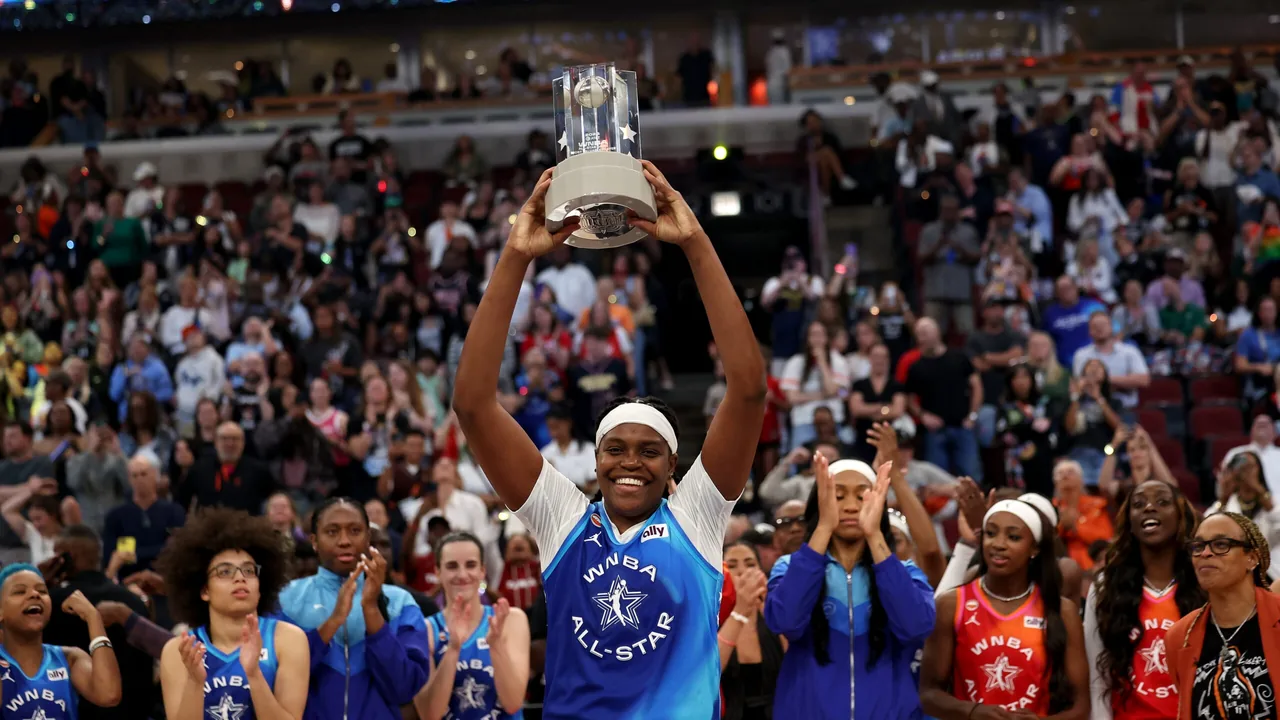
The 2026 WNBA All-Star weekend has a clear set of final answers: Team Spoon beat Team Coop 129–122, Jonquel Jones was the game MVP, Azzi Fudd won the 3-Point Contest, and a Washington trio won Kia Shooting Stars. This recap uses the final July rosters, including the late replacement that an earlier draft graphic may miss. The Chicago events are over, so these results are historical even if you are checking them during a later WNBA game day.
Who won the 2026 WNBA All-Star Game?
Team Spoon won Saturday's main event over Team Coop at United Center in Chicago on July 25, 2026. The WNBA final recap confirms both the 129–122 score and Jones's MVP award. “Spoon” refers to Teresa Weatherspoon and “Coop” to Cynthia Cooper-Dyke, the two WNBA legends who selected the special rosters. The exhibition brought players from many clubs onto two temporary sides; its result was not a regular-season win for any one franchise.
The venue matters because Friday's two contests were held elsewhere in Chicago. A fan who attended or watched a clip may see both buildings mentioned under the same All-Star weekend label. United Center hosted this Saturday game, while Wintrust Arena hosted Friday's shooting events. Event, date and building together are more precise than “All-Star in Chicago.”
Team Spoon's 129–122 win
Team Spoon's seven-point victory followed an early burst from Caitlin Clark. The Golden State Valkyries' game report says she scored 11 of her side's first 13 points and finished with 17. On the other side, Indiana Fever guard Kelsey Mitchell led every player in the game with 28 for Team Coop. Teammate Gabby Williams added 18 with four made three-pointers. Team Spoon led by as many as 18 and did not trail by more than a point, according to that team account.
Outside shots formed a major part of the show. The WNBA postgame reaction tallied 127 three-point attempts between the teams and 41 makes. Those figures help explain why scorers from both sides had room to make a run; they should not be recast as a formal new league record without a separate record check. Dominique Malonga also dunked during the game, a highlight separate from the final margin.
The All-Star sides were not the Indiana Fever versus New York Liberty or any other scheduled club matchup. If you want results from current league games, current WNBA scores provide a date-based route. The 129–122 score here belongs to this one July exhibition, whose special rosters are listed below.
Why Jonquel Jones was MVP
Jones supplied 22 points, 13 rebounds and eight assists for Team Spoon. The league's game account also reports four made threes and 8-for-17 field-goal shooting. Her second-half contribution helped turn a strong overall line into the night’s individual award. The scoring, boards and passing show why her impact is better described as all-around than by her points alone.
Mitchell scored more points than Jones, yet Mitchell played for the losing side and Jones received MVP. That is a useful distinction for anyone scanning only the scoring column: the game's high scorer and the selected MVP need not be the same player. Jones created shots for teammates with eight assists and helped Team Spoon secure possessions with 13 rebounds while adding an outside threat. Those are recorded contributions; no unpublished award-vote margin is needed to explain the outcome.
The MVP trophy joined Jones's earlier league honors, including 2021 regular-season MVP, 2023 Commissioner’s Cup MVP and 2024 Finals MVP, as the WNBA reaction recounts. Those prizes belong to different competitions and seasons. This particular award recognizes her July 2026 All-Star performance, not her entire 2026 regular season. For a fan remembering the Saturday game, the short answer is Team Spoon 129, Team Coop 122, with Jones taking MVP.
Which players were on the final Team Spoon and Team Coop rosters?
The completed 2026 All-Star Game used two 11-player sides. The July 15 WNBA draft release gives their original pick order, while the league's July 22 replacement announcement explains the one final change: Kahleah Copper of Phoenix replaced injured Kelsey Plum of Los Angeles on Team Coop. The final league roster page shows Copper. The table below therefore lists the event's final groups rather than putting both Plum and Copper into the same eleven.
| Team Spoon | Team Coop |
|---|---|
| Caitlin Clark | Paige Bueckers |
| A'ja Wilson | Breanna Stewart |
| Olivia Miles | Kelsey Mitchell |
| Aliyah Boston | Natasha Howard |
| Jessica Shepard | Gabby Williams |
| Rhyne Howard | Angel Reese |
| Allisha Gray | Marina Mabrey |
| Jonquel Jones | Dominique Malonga |
| Courtney Williams | Kahleah Copper |
| Kiki Iriafen | Jackie Young |
| Nneka Ogwumike | Sonia Citron |
Caitlin Clark was on Team Spoon; Paige Bueckers was on Team Coop. That answers two common roster searches immediately. It also helps explain why fans saw an Indiana Fever pairing split across the sides: Clark joined Spoon, while Fever scorer Kelsey Mitchell played for Coop. Aliyah Boston, another Indiana player, joined Clark on Spoon. The All-Star format assembled individual selections from across the league rather than moving full clubs into the game.
The draft-night table and the final table are not competing claims about the same moment. Cooper originally selected Plum; the commissioner's later substitution placed Copper in her spot after an injury. An archived July 15 graphic can honestly show Plum, while a recap of who was available for July 25 should show Copper. Neither player becomes a twelfth member of Team Coop by being mentioned in the history of that roster. The final side remains eleven players.
Weatherspoon and Cooper-Dyke were special general managers for Team Spoon and Team Coop, respectively. Cheryl Reeve coached Spoon on the bench; Becky Hammon coached Coop. The league's July release states those roles separately, even if a casual headline describes the sides by the legends' names. The names in the table are also 2026 event affiliations: they are useful for identifying who played in this exhibition, not a substitute for a live 2027 club roster or transaction tracker.
Several of the event's standout moments make more sense when the roster is in view. Jones's MVP belongs to the Spoon column. Mitchell's game-high 28 and Gabby Williams's scoring belong to the losing Coop column. Reese, a later record-setting Atlanta rebounder, was on Coop even though fellow Atlanta players Rhyne Howard and Allisha Gray were on Spoon. That split illustrates the league-wide selection process rather than any club rivalry or trade.
Who won the 2026 3-Point Contest and Shooting Stars?
Friday, July 24 featured two competitions at Chicago's Wintrust Arena, one day before the All-Star Game at United Center. The league's formal Friday program named the State Farm WNBA 3-Point Contest and Kia WNBA Shooting Stars. Their winners were Dallas Wings rookie Azzi Fudd and Team Washington's three-person group, respectively. These were separate contests with separate scoring systems, so the numbers below should not be mixed with Saturday's 129–122 game or ordinary WNBA club results.
The two formats also offered different things to watch. Fudd had to shoot from a series of racks against other individual perimeter players. Shooting Stars paired a former league star, a current WNBA player and a rising high-school player, putting three generations on the same timed team. The first rewarded individual shooting under pressure; the second rewarded a group's decisions and makes across marked spots on the court.
Azzi Fudd's 30-point 3-Point final
Fudd defeated Portland Fire shooter Bridget Carleton in the final round, scoring 30 contest points. The Golden State Valkyries' event report identifies both finalists and the winning total, while the WNBA's highlight page confirms she became the first rookie to win the competition. The “rookie” label describes her WNBA experience in 2026, not a separate youth contest.
The league's Friday reaction reports Fudd made 20 of 26 attempts in the final. A rack contest can award different point values to different shots, so the made-shot count and 30-point contest score answer related but different questions. The 30 should not be added to her Dallas regular-season points, nor should it be confused with Jones's Saturday MVP line. Carleton was the runner-up, but the checked league winner recap does not require a speculative final score for her.

Other accomplished shooters made the field meaningful: the WNBA's Friday account names Rhyne Howard, Natisha Hiedeman and Marina Mabrey among the veteran entrants. Fudd's title came by outshooting an event field, not by being the highest scorer in Saturday's All-Star Game. If you are trying to find an upcoming Dallas matchup after revisiting this moment, the WNBA TV schedule lists current broadcast assignments; it is not a replay archive for the July contest.
Team Washington's 31-point Shooting Stars win
Elena Delle Donne, Shakira Austin and Jezelle “GG” Banks represented Team Washington and scored 31 points to win. The WNBA's winner page names all three, removing any doubt about which Washington group the headline means. Delle Donne was the WNBA legend, Austin the current player and Banks the Nike EYBL high-school standout. Team Seattle was the other finalist in the league's Friday reaction.
The official rules description gave teams 70 seconds to shoot from seven locations, beginning with close attempts and stretching to longer-range shots. The two best opening-round teams advanced to a championship round. That setup makes a four-point Banks shot important even though it was not a four-point field goal in a standard WNBA game. It was an event scoring spot in a timed skills-and-shooting challenge.
“Washington” was the event team's label and celebrated a connection to the Mystics; it did not mean the regular Washington Mystics roster defeated the Seattle Storm 31–something on July 24. The winning trio combined different basketball generations for this one exhibition program. Fudd's individual 30 and Team Washington's 31 are both real Friday outcomes, but the point totals belong to different contests and cannot be used to say one winner outscored the other in a shared match.
Why do older 2026 All-Star pages say Skills Challenge?
An older league page can say the 2026 weekend included a “Skills Challenge,” while final July coverage names Shooting Stars as Friday's second professional competition. Both pages have a real publication history. The October 2025 host announcement promised a 3-Point Contest and Kia WNBA Skills Challenge for Friday at Wintrust Arena. The January 2026 season release repeated that planned label. Neither was written after the Chicago contests had taken place.
By July, the official program named Kia WNBA Shooting Stars with its legend, current-player and high-school teams. The postevent WNBA account describes the two Friday professional events as Shooting Stars and the 3-Point Contest. Team Washington is the confirmed winner of the former. The checked final event reports do not give a separate winner for a professional Friday “Kia Skills Challenge,” so a recap should not invent one to match an earlier schedule headline.
The phrase did appear elsewhere that weekend. The WNBA Live festival program listed a Skills Challenge for the Women’s Basketball Without Borders All-Star Camp at McCormick Place. It involved camp athletes representing regions, not the Friday professional group at Wintrust. A search snippet may drop the “camp” qualification and create another apparent contradiction. Checking both venue and participants shows which competition a page actually means.
For a fan asking who won the headline Friday program, the reliable answer is Fudd for the 3-Point Contest and Delle Donne, Austin and Banks for Shooting Stars. For a fan reading an archived October or January announcement, the planned Skills wording explains why the phrase is still indexed. There is no need to guess why the professional event name or format changed; the dated league releases establish what was announced and what ultimately ran.
How were the 2026 WNBA All-Stars chosen?
The final roster table answers who was there; the selection process explains how those names reached Team Spoon and Team Coop. The league first chose a pool of 22 All-Stars: ten starters and twelve reserves. It then let the two special general managers divide that pool into the temporary game sides. Those are separate stages, so a player could be a voted starter yet appear on a team selected by a legend who did not cast the starter vote.
For the starters, the WNBA's July 2 release gives fans 50% of the weighted decision, current WNBA players 25% and a media panel 25%. The result comprised four guards and six frontcourt players. Fan voting carried the largest share and served as a tie breaker in a position group, but the other two groups still mattered. That is why a raw fan-vote leaderboard alone cannot fully reproduce the final starter order.
The league's 15 head coaches selected the 12 reserves. They voted for guards, frontcourt players and flexible spots and could not vote for their own players, according to the starter and reserve announcements. That step completed the 22-person pool. It did not directly decide whether a reserve would later play for Spoon or Coop; the special draft assigned those sides after selection.
Cynthia Cooper-Dyke and Teresa Weatherspoon served as honorary general managers for the WNBA's 30th-season celebration. The official draft report says they made picks without regard to a player's conference or position. A coin flip first gave Coop the highest fan vote-getter, Paige Bueckers; Spoon received second-leading Caitlin Clark. Weatherspoon then selected A'ja Wilson with her first remaining starter pick, while Cooper chose Breanna Stewart. The assignment of the two leading fan choices explains why those names appear at the top of the draft table even though the rest followed the open selection sequence.
The bench coaches came through another route. Becky Hammon of Las Vegas coached Team Coop, and Cheryl Reeve of Minnesota coached Team Spoon. Their clubs had the best records through the league's July 10 cutoff; both were 16–6, and Las Vegas took the top slot on a head-to-head tie breaker. Thus Cooper and Weatherspoon selected rosters as honorary GMs, while Hammon and Reeve coached the game. A coach's club record did not make every player on that club an automatic All-Star.
Finally, a roster can change after the draft. The commissioner named Kahleah Copper to Team Coop when Kelsey Plum could not play, leaving eleven final names on that side. That adjustment is why the completed-event roster above is the right answer for July 25, while the first draft table remains useful for understanding the selection story.
All-Star selection rewarded individual players for this exhibition and should not be read as a league championship. The 2025 WNBA Finals results concern a competitive title series between clubs; Team Spoon's 129–122 belongs to a different kind of game. For the actual matchups on a later date, use today's WNBA games. The 2026 All-Star rosters and Friday winners remain fixed historical answers even while live schedules, player clubs and future All-Star selection rules change.
Sign in with Google to join the discussion.