
Who won the 2026 WNBA Finals?
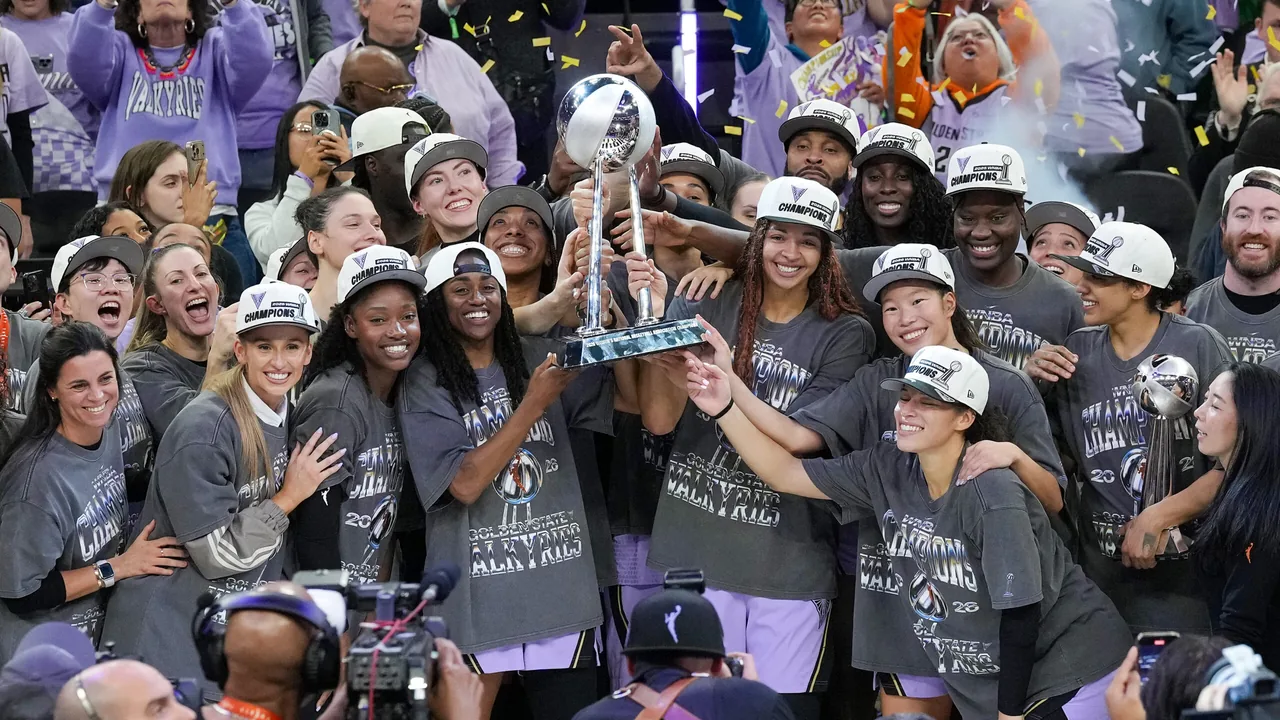
The Golden State Valkyries won the 2026 WNBA Finals, beating the Atlanta Dream 4–3 for the first championship in franchise history. Golden State clinched the title with a 68–63 win on October 31 at Chase Center in San Francisco. Gabby Williams scored 30 in the deciding game and earned Finals MVP, according to the Valkyries’ championship announcement.
The No. 2 seed earned four home games against fourth-seeded Atlanta under the league’s 2–2–1–1–1 Finals format. Golden State hosted the first two, then Games 5 and 7. Atlanta’s three home games were at State Farm Arena. Each team took one game on the other’s floor. That left Golden State with three home wins and one away win, a path that depended as much on the split in Atlanta as it did on closing in San Francisco.
| Game | Date | Venue | Final score | Series after game |
|---|---|---|---|---|
| 1 | Oct. 17 | Chase Center | Golden State 68, Atlanta 64 | Golden State 1–0 |
| 2 | Oct. 19 | Chase Center | Atlanta 79, Golden State 65 | Tied 1–1 |
| 3 | Oct. 21 | State Farm Arena | Atlanta 97, Golden State 71 | Atlanta 2–1 |
| 4 | Oct. 24 | State Farm Arena | Golden State 67, Atlanta 62 | Tied 2–2 |
| 5 | Oct. 26 | Chase Center | Golden State 64, Atlanta 55 | Golden State 3–2 |
| 6 | Oct. 29 | State Farm Arena | Atlanta 80, Golden State 69 | Tied 3–3 |
| 7 | Oct. 31 | Chase Center | Golden State 68, Atlanta 63 | Golden State 4–3 |
The unusual feature of the scorecard is that Atlanta outscored Golden State 500–472 overall. The Dream won their three games by 14, 26 and 11 points. Golden State’s four wins were by four, five, nine and five. Atlanta had the more emphatic wins. Across seven starts with fresh scoreboards, Golden State had the extra win. That distribution matters when assessing this matchup. A double-digit victory showed how far one game could swing once a team found a rhythm. The series turned on which side could get enough stops and scores in the closer games.
The biggest swing straddled the middle of the series. Atlanta turned a loss in the opener into a 2–1 lead, capped by its 26-point Game 3 win. Golden State answered with two wins in a row while holding the Dream below 65 points both times. Game 6 restored the balance and sent the series back to the building that hosted the opener. The complete WNBA playoff bracket and scores place the seven Finals games beside the first round and semifinals. The league’s Finals video archive offers a recap for each game.
How Atlanta took a 2–1 series lead
The first three games showed how quickly the scoring terms could change. In the opener, Golden State got one double-figure scorer and still found enough extra chances to win. Atlanta then took a road game on the strength of its defense and Angel Reese’s work around the basket. Back in Atlanta, the Dream turned a competitive third quarter into the biggest margin of the Finals.
Game 1 gave Golden State the opening edge
Gabby Williams scored 26 of Golden State’s 68 points. She produced 16 in the second quarter after going scoreless in the first, then made six free throws in the final stretch. Those points held up because the Valkyries got a steady supply of extra chances. They took the rebounding battle 41–35 and collected 12 offensive boards to Atlanta’s seven. Kiah Stokes blocked four shots, and Kaila Charles supplied 10 rebounds from the bench. On a night when the ball struggled to fall for either side, a rebound extended a possession and another defensive stop made the next scoring chance more valuable. Golden State’s Game 1 recap
Atlanta scored eight points in the fourth and went 2-for-19 from the field in the period. Allisha Gray finished with 19 points, while Reese grabbed 12 rebounds and scored 14. Golden State managed to contain several different Atlanta threats through the end of a tight game. The Dream still had a capable scorer inside and had played close enough to make the next meeting in the same building a fresh test.
Atlanta won Games 2 and 3 in different ways
Reese produced 30 points and 16 rebounds and made 10 of 16 field-goal attempts in Game 2. Gray added 18. The game was tied at 40 early in the third, then Atlanta stretched its advantage with a long run and built a 21-point lead in the fourth. The Dream had a two-point lead at halftime. They won by 14, holding Golden State to nine points in the third. The club’s first Finals victory gave it a split of the two games in San Francisco and a chance to take control on its home floor. WNBA Game 2 box score
Reese had 21 points and 12 boards in Game 3. Rhyne Howard contributed 16 points and Naz Hillmon added 15, giving Atlanta scoring from several places. A tie at 49 in the third became an eight-point Dream lead. Golden State had one more response and cut the margin to four, then Atlanta scored 12 of the last 14 points in the quarter. The Dream’s 97 points showed what could happen when their top scorers sustained pressure beyond a single run. Golden State went into Game 4 needing a way to keep that kind of scoring stretch from deciding the night. WNBA Game 3 summary
Golden State’s response in Games 4 through 6
Golden State recovered home-court advantage with its Game 4 win in Atlanta and moved ahead in Game 5. Its defensive work mattered in both games. The Valkyries won despite scoring fewer than 70 points each time. Atlanta then raised the shooting standard in Game 6, when it became clear how little margin either team had for a slow start.
The rotation change in Games 4 and 5
Natalie Nakase moved Tiffany Hayes and Kaila Charles into the starting lineup in Game 4, with Kayla Thornton and Cecilia Zandalasini shifting to reserve roles. Golden State led 42–26 at halftime. Hayes scored all 13 of her points after halftime, while Zandalasini contributed 10 points off the bench. The new opening group could get Golden State into the game earlier, while moving a capable scorer to the second unit gave Nakase another combination to use when Atlanta cut into the lead. Golden State’s Game 4 report
Ball security gave the lineup change some room to work. Golden State had nine turnovers in Game 4 to Atlanta’s 18, and it added 16 points off those mistakes. Atlanta narrowed the gap late, yet the Valkyries held on 67–62. If you revisit the game, pay attention to the passes that followed a stop. Getting a clean possession going in the other direction was particularly valuable with both teams doing enough to make half-court scoring difficult.
Game 5 at Chase Center tightened those conditions. Golden State was up 25–22 at halftime and had only 64 points by the end. Kiah Stokes hit three 3-pointers, scored 13 and blocked three shots. Veronica Burton also had 13 and blocked four. The Valkyries again finished with nine turnovers while the Dream had 17. Golden State’s 21 points off turnovers, compared with six for Atlanta, give a sense of where scoring came from on a night when the overall totals were low. A Stokes block challenged an attempt at one end, and her shooting gave Atlanta another player to close out at the other. Golden State’s Game 5 report
Atlanta found its shooting again in Game 6
The Dream outscored the Valkyries 32–15 in the opening quarter back at State Farm Arena. Allisha Gray finished with 23 points and made five 3-pointers. Rhyne Howard scored 21 and made four. Reese added 15 points and 14 rebounds. Together, Gray and Howard accounted for 44 of Atlanta’s 80 points. Their perimeter scoring gave the Dream a substantial lead to defend. WNBA official scorer’s Game 6 book
Williams scored 26, with 21 coming after halftime. Golden State got as close as eight in the fourth quarter after trailing by as many as 25, according to its team report. Atlanta held those late possessions and won by 11. The final margin was much smaller than the biggest lead, a reminder that the opening quarter still counted even after Golden State had regained its footing. The next tipoff would start at zero again, with each team knowing a fourth win would be enough. Golden State’s Game 6 report
How Golden State won Game 7
The first Game 7 in WNBA Finals history turned on a handful of possessions in the fourth quarter. Golden State had opened with a strong stretch of defense, fallen behind at halftime and recovered just enough in the third to take a one-point lead into the last period. Atlanta had answers well into the fourth. The deciding margin came from the way Golden State put points together with rebounds and free throws.
Atlanta led by six at halftime
Four Valkyries combined for five blocks in the opening quarter. Atlanta went more than five minutes without a point. Yet the Dream cut into the early deficit, trailed by only two after one and led 30–24 at halftime. Golden State’s initial stops had bought it time in a half when its own shots were scarce. The game was still close enough for a good quarter to erase most of Atlanta’s advantage. Golden State’s Game 7 report
Williams took over more of the offense in the third quarter. She scored 15 in the period, including Golden State’s last 11 points of the quarter. The Valkyries ended it ahead 45–44. Atlanta’s six-point halftime advantage had become a one-point deficit in a game where both sides had been mostly unable to string baskets together. Golden State could enter the last 10 minutes with enough cover for the inevitable empty possessions to come. WNBA Game 7 live-blog archive
Gabby Williams and the closing possessions
Howard tied the game at 57 with a driving layup with 2:41 remaining. Williams got the lead back with a 3-pointer off a Burton assist. She added two free throws at 1:40. Stokes then kept a late possession going by grabbing offensive rebounds and tipping in a basket for a 64–57 lead. Just as a missed shot gave Golden State another chance, Atlanta also found a fresh shot on a late offensive rebound. Gray used that possession to hit a three that kept the Dream close. Game 7 play-by-play
Atlanta went to the line late and got within three. It forced a jump ball with enough time for another possession. Burton recovered it after the tip, drew the foul and made two free throws to finish the scoring. Golden State went 15-for-16 at the line as a team. Stokes finished with 13 rebounds and two blocks. Her extra chance near the rim and Burton’s recovery on the jump ball held up the scoring lead that Williams had created. The Game 7 box score and game details allow fans to revisit those contributions alongside the scoring line.
Why Gabby Williams won Finals MVP
Williams averaged 19.6 points and 2.6 steals in the Finals, leading all players in both categories. She scored in double figures in six of the seven games. The deciding game was her highest scoring night of the series, with 28 of her 30 points after halftime. She also had four blocks and two steals, adding defensive plays during the same game in which Golden State relied on her to break the scoring deadlock. Golden State’s Finals MVP announcement

Her Game 7 shooting line illustrates how she found those points. Williams made 10 of 23 shots, including four of eight from beyond the arc. She converted all six attempts at the line. The mix gave Golden State ways to score even when Atlanta limited easy baskets. A drive could get Williams to the foul line, a three could flip a tied score in one possession, and a defensive stop could give her the ball again before Atlanta got its defense in place.
Game 6 puts the award in a wider context. Williams had scored 26 in the loss in Atlanta, where the Dream built a lead large enough to absorb her run after halftime. In the opener she had also scored 26, closing the win at the foul line. The postseason award reflects a series of games where Golden State repeatedly needed those skills at both ends. Her work in the second half of Game 7 brought the other pieces together at the moment there was a title to win.
What the series meant for both franchises
Golden State won the championship in its second season. The Valkyries had to take a deciding first-round game against Dallas, swept defending champion Las Vegas in three games in the semifinals and needed the maximum of seven games to beat Atlanta. The full postseason record was 9–4. The title run showed how much could change from one matchup to the next. Golden State scored 104 in its playoff opener against Dallas, then won two Finals games with 67 points or fewer. Valkyries championship timeline
Williams won MVP, and several teammates put together standout series of their own. Stokes finished with a Finals series record of 19 blocks, starting with four in the opener and adding two in the clincher. Hayes scored 82 across the seven games, second on the Valkyries, and moved into the starting lineup midway through the series. Their impact helps explain how Golden State could win tight games when the total points on its side of the scoreboard were modest. Golden State’s season review
Atlanta swept Washington and New York on its way to a fourth Finals appearance, having previously reached the championship round in 2010, 2011 and 2013. Game 2 was the Dream’s first Finals game win, followed by two more in Atlanta. The Dream entered Game 7 with a chance at their first league title and led at halftime on the road. What makes this appearance distinct in Atlanta’s history is the club’s path all the way to the last few possessions of a deciding game. Atlanta’s account of its first Finals win
For the story before tipoff, follow how the finalists built their rosters. The Golden State Valkyries schedule and Atlanta Dream schedule connect this series with each team’s other games. The final result stands on its own. Atlanta had a chance to win the title in San Francisco, and the Valkyries made the decisive plays to finish Game 7 at home.
Sign in with Google to join the discussion.