

The WNBA has Eastern and Western Conferences, but it does not reserve four playoff places for each side. Teams belong to a conference for league organization, schedule context and the Commissioner's Cup. For the ordinary postseason, the eight best regular-season records across the entire league qualify and are seeded No. 1 through No. 8.
The short answer: conferences organize teams but do not reserve playoff berths
This distinction explains why two apparently different standings views can both be correct. A broadcaster or statistics site may group clubs under East and West headings because those are real league affiliations. The official playoff race, however, compares every team together. A fifth-place Eastern team can qualify ahead of a fourth-place Western team if its overall winning percentage is better, and the reverse is equally possible.
Conference record is still useful information. It tells a fan how a club performed against opponents from its own side, and designated intraconference games determine the Commissioner's Cup finalists. It can also illuminate schedule context and rivalries. What it does not do is grant an automatic WNBA playoff berth or seed in the current format.
The simplest mental model is to separate three questions:
- Where is a team organized? Eastern or Western Conference.
- Where does it stand for the playoffs? In the league-wide order by regular-season record, with official tiebreakers applied when needed.
- Where does it stand in the Commissioner's Cup? Against its own conference during designated Cup games.
This article explains that framework and deliberately avoids a static table of today's records. Results, games behind and seeds change whenever games finish. Use the site's live 2026 playoff picture for the current order; use this guide to understand why that order may look different from an East/West display.
Which teams are in the Eastern and Western Conferences in 2026?
The WNBA has 15 active teams in 2026, divided into a seven-team Eastern Conference and an eight-team Western Conference. The uneven split is simply the result of an odd total. Toronto Tempo entered the East and Portland Fire entered the West for their 2026 debut seasons, one year after Golden State joined the West.
| Eastern Conference (7) | Western Conference (8) |
|---|---|
| Atlanta Dream | Dallas Wings |
| Chicago Sky | Golden State Valkyries |
| Connecticut Sun | Las Vegas Aces |
| Indiana Fever | Los Angeles Sparks |
| New York Liberty | Minnesota Lynx |
| Toronto Tempo | Phoenix Mercury |
| Washington Mystics | Portland Fire |
| — | Seattle Storm |
These are official affiliations, not a ranking. Alphabetical placement in this table says nothing about a team's record, seed or strength. It also does not mean every regular-season opponent comes from the same conference. Each club plays a 44-game schedule with 22 home and 22 road games, including both intraconference and interconference matchups.
The addition of Toronto and Portland is useful for remembering the 2026 alignment: Toronto is the newest Eastern member, and Portland is the newest Western member. Their May meeting was an ordinary interconference game. During the designated Commissioner's Cup window, however, they competed in separate conference pools. The same affiliations can therefore serve different functions depending on which competition a standings page is showing.
For markets, home cities, expansion context and direct links for every club, use the complete 2026 WNBA team directory. Fans following the league's first Canadian franchise can use the Toronto Tempo schedule for changing dates, scores, venues and channels. A live team page is more reliable for those details than a fixed conference explainer.
How to read a WNBA standings row
Before interpreting a row, confirm which standings view is selected. The official site offers regular-season and Commissioner's Cup views, and they answer different questions. The ordinary regular-season table uses overall results as its foundation. Its conference column is a split inside that larger record, not a separate playoff table.
- W and L are overall regular-season wins and losses.
- PCT is winning percentage: wins divided by games played. It is more useful than raw wins when clubs have temporarily played different numbers of games.
- GB means games behind the leader. A dash marks the leader; half-game increments can appear when teams have played unequal totals.
- CONF is the team's win-loss record against opponents in its own conference.
- HOME and ROAD split the overall record by game location.
- STREAK shows the current run, such as W3 for three consecutive wins or L2 for two consecutive losses.
- L-10 summarizes the most recent 10 games, offering short-term context beside the full-season record.
Imagine an Eastern team listed at 10-5 overall and 6-2 in CONF. It has won 10 of 15 regular-season games, for a .667 winning percentage, and six of its wins plus two of its losses came against Eastern opponents. The remaining seven games were against Western teams. The 6-2 split may describe a strength against familiar conference opponents, but the 10-5 overall mark is the record used to compare it with every club for playoff position.
Games behind is a convenience for seeing distance from first place, not a separate qualification rule. Winning percentage and the official tiebreak procedure determine the ordering when schedules or records require closer comparison. Likewise, a hot L-10 or long winning streak can describe momentum without erasing what happened earlier in the season.
The site's current WNBA schedule and results is the appropriate place to follow the games that change those columns. When a game becomes final, W-L, PCT, GB, location splits, streak and L-10 may all move together. This guide stays useful by explaining the fields rather than freezing values that will be obsolete after the next result.
How WNBA playoff qualification and seeding work
The 2026 WNBA playoff field contains the top eight teams by overall regular-season record, regardless of conference. With 15 clubs, that means eight qualify and seven miss. There is no rule promising four Eastern and four Western berths, and finishing fourth within one conference does not by itself clinch anything.
After qualification, the same league-wide order determines seeds. No. 1 plays No. 8, No. 4 plays No. 5, No. 3 plays No. 6, and No. 2 plays No. 7. All eight qualifiers enter in the first round, so there are no first-round byes. The bracket keeps the 1-vs-8 winner on the same semifinal path as the 4-vs-5 winner, while the other two first-round winners occupy the opposite side.
Conference affiliation does not constrain those pairings. Two Eastern teams can meet in the first round if their overall seeds match one of the four pairings. They can also meet in the Finals if they begin on opposite sides of the league-wide bracket and both advance. That is a direct consequence of record-based seeding, not an exception that requires special approval.
This system makes the eighth-place league line more important than either conference's fourth-place line. It also makes every seed meaningful. Moving from eighth to seventh changes the opening opponent; moving into the top four changes which seed a team hosts or faces within the bracket's home-court structure. A team may clinch a berth before it locks its final seed because later results can still change the order.
The full 2026 playoff format guide covers series lengths, home-court patterns and confirmed dates. For conference interpretation, remember only the governing sequence: overall record selects the eight teams, official tiebreakers separate equal records, and the resulting No. 1–No. 8 list creates the bracket.
WNBA standings tiebreakers in the correct order
Equal overall records do not send the league back to separate conference standings. The official WNBA standings publish one tiebreak procedure for playoff eligibility and home-court advantage. Criteria are applied in this order:
- Better head-to-head record. Compare the tied teams' results against one another.
- Better winning percentage against teams that finish .500 or better. The wording matters: the comparison group is based on final regular-season records, so a borderline opponent can enter or leave that group late in the season.
- Better point differential in head-to-head games. Add points scored and allowed only in the games between the tied teams, then compare the resulting margins.
- Better point differential against all opponents. If the first three criteria do not separate the teams, the full-season scoring margin becomes the next test.
Conference record is absent from that sequence. A club can have the better CONF split and still lose an ordinary playoff-seed tie at the first criterion because the other team won their season series. This is one of the most important differences from leagues that use division or conference record early in their postseason tiebreaks.
Multi-team ties require an extra procedural step. The league applies the criteria to all tied teams. When one or more teams are eliminated at a step, the process starts again from head-to-head for the teams that remain tied. It does not simply continue down the list using a comparison that included a club already separated.
For example, imagine three teams tied for the final two seeds. If head-to-head results clearly put Team A first but leave Teams B and C even, A takes the highest available position. B and C then restart at criterion one as a two-team tie. The example explains the process; the actual records and eligible .500 opponents must always be calculated from the final official results.
Do not use this list to settle a Commissioner's Cup tie. The Cup publishes separate rules because it compares designated conference games and chooses one finalist from each side. For current playoff-line status before final tiebreaks are settled, consult the live playoff picture.
The Commissioner's Cup is where conferences directly decide finalists
If a fan says conference standings matter in the WNBA, the Commissioner's Cup is the clearest current example. The Cup is a competition nested inside the regular season. In 2026, its pool games ran from June 1 through June 17, and every team played each opponent in its own conference once. That produced six designated games for each of the seven Eastern teams and seven for each of the eight Western teams.
Those games served two purposes at once. Each result counted in the club's ordinary 44-game regular-season record, while also building a separate Cup record within its conference. The team with the best Cup record in the East and the team with the best Cup record in the West advanced to the championship. The title game itself was a standalone Cup game and did not count toward the regular-season standings.
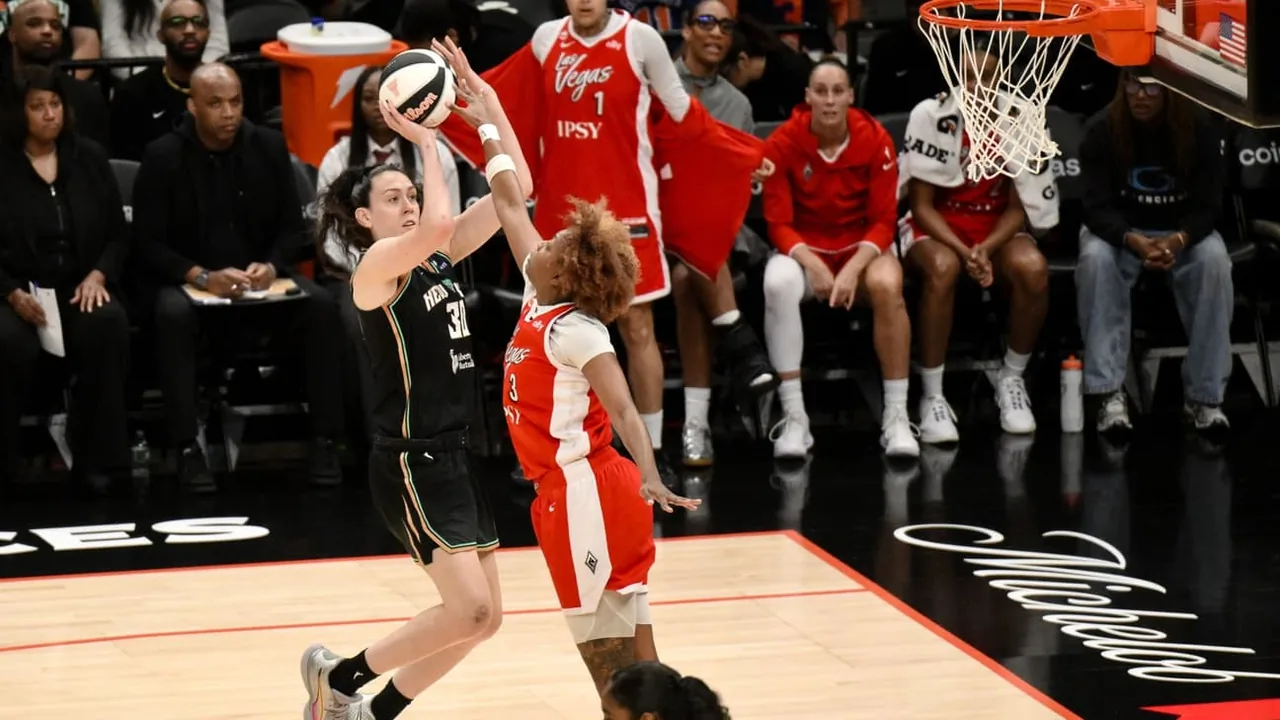
New York went 6-0 in Eastern pool play and Las Vegas went 6-1 in the West, so they represented their respective conferences in the June 30, 2026 final. New York won 93-85. That result illustrates the distinction neatly: conference-specific results selected the finalists, but the Cup championship score did not change either team's regular-season W-L line. The site's 2026 Commissioner's Cup final and standings guide records the completed pool race and title-game result.
Cup ties follow a different procedure from playoff-seed ties. A two-team Cup tie starts with head-to-head results, which is decisive because conference opponents met once in the designated window. For a multi-team tie, the league moves through results among the tied clubs, Cup point differential, total Cup points scored, regular-season intraconference winning percentage and, if still necessary, a random drawing.
That separate rulebook is why the selected standings tab matters. A regular-season CONF column describes one slice of a team's complete record. A Cup leaderboard ranks only designated intraconference games and can directly award a place in the Cup final. Neither the Cup order nor its tiebreak sequence replaces the league-wide table used to choose and seed the eight WNBA playoff teams.
Why the WNBA still has conferences after changing its playoff system
Today's combination of official conferences and a league-wide playoff table makes more sense with one historical date in view. Before 2016, the top four teams in the Eastern Conference and the top four in the Western Conference qualified. Each side held its own conference rounds, and the two conference champions met in the WNBA Finals. In that system, a team's position within East or West directly controlled its postseason path.
The league changed qualification for the 2016 season. From then on, the eight teams with the highest winning percentages qualified regardless of conference and received overall seeds. The precise round structure adopted in 2016 has since been revised, but the central league-wide qualification principle survived. The current bracket puts all eight qualifiers into four first-round series instead of restoring separate East and West playoff brackets.
Removing the conference quota did not abolish the conferences themselves. Every club still carries an official Eastern or Western affiliation, which provides a stable way to organize a growing team directory. The CONF field also gives fans a consistent performance split: it answers how a team has fared against the other clubs on its side even when that split does not award an ordinary playoff place.
The Commissioner's Cup gives the alignment a direct competitive job. Designated games take place within each conference, and one team from each side advances to the title game. That structure can coexist with a postseason that selects the best eight records across both sides. “Conference champion” in older playoff history and “conference winner” in current Cup play therefore describe different achievements.
Expansion makes careful wording especially important. Team counts and alignment can change when a new club begins play, while the playoff rule can remain league-wide. The 2026 team directory is the better reference for membership details. For standings analysis, treat East and West as real organizational groups, then ask whether the page is showing an overall playoff race, a conference split or a Cup pool before drawing a conclusion.
A practical way to follow conference standings and the playoff race
You can interpret almost any WNBA standings update correctly by following the same order. Start with the competition and overall record, then add conference context. This prevents the CONF column or a Cup table from being mistaken for the playoff cut line.
- Identify the table. Check whether the page says regular season, playoffs or Commissioner's Cup. Similar team names and W-L columns can represent different sets of games.
- Sort the regular-season race league-wide. Compare PCT across all 15 teams. The relevant playoff boundary is between eighth and ninth overall, not between fourth and fifth in either conference.
- Check games played and GB. Raw wins can mislead when schedules are temporarily uneven. PCT shows the rate; GB gives a quick measure of distance from the leader.
- Apply tiebreakers only when needed. Begin with head-to-head, then follow the published order. Do not substitute conference record merely because it appears beside the tied teams.
- Add the correct context. Use CONF to evaluate intraconference performance, HOME/ROAD for location splits, and L-10 or STREAK for recent form. Switch to the Cup leaderboard only when analyzing Cup advancement.
Because scores continually change the order, use the current WNBA schedule and results to verify which games are final before reading a standings snapshot. A postponed, live or recently completed game can explain why two clubs have unequal games played. For qualification, clinching and seed movement interpreted in one place, the 2026 playoff picture is designed for the changing race.
How many teams are in each WNBA conference? In 2026, seven teams are in the Eastern Conference and eight are in the Western Conference. Toronto's debut placed a seventh club in the East, while Portland's debut placed an eighth in the West.
Do the top four teams in each conference make the WNBA playoffs? No. That describes the league's system before the 2016 change. The current field is the top eight regular-season teams across the league, regardless of conference, so the East-West distribution can be uneven.
What does CONF mean in WNBA standings? CONF is a team's regular-season win-loss record against opponents in its own conference. It is useful as a performance split, but it is not an automatic berth and is not listed in the ordinary playoff tiebreak sequence.
Can two teams from the same conference meet in the WNBA Finals? Yes. The bracket is seeded league-wide rather than divided into separate East and West halves. Same-conference teams placed on opposite sides can reach the Finals if both win their earlier series.
What is the first WNBA standings tiebreaker? Head-to-head record is first for playoff eligibility and home-court advantage. If that does not resolve the tie, the league proceeds to winning percentage against teams that finish .500 or better, then head-to-head point differential and overall point differential.
The lasting rule is simple: conference affiliation tells you who belongs to the East or West, while overall regular-season performance decides who enters the WNBA playoffs and where each qualifier is seeded. Conference results become decisive in the Commissioner's Cup, not as a hidden shortcut into the ordinary postseason.
Sign in with Google to join the discussion.