

How the WNBA began in 1996
The WNBA began play in 1997, but its formal launch started a year earlier. On April 24, 1996, NBA governors approved the concept of a women's professional basketball league scheduled to begin the following summer. The distinction matters when fans ask “When did the WNBA start?” The 1996 date marks the approval and organization of the league; June 1997 marks the first official games. By October 2026, the WNBA is in its 30th playing season, counting 1997 as season one.
The year between approval and tipoff involved building more than a schedule. The league named Val Ackerman its first president in August 1996. Sheryl Swoopes became the first player signed that October, and the league then announced the eight cities that would compete in its inaugural season. Players were allocated to teams in January 1997, and Houston selected Tina Thompson with the first overall pick in the first WNBA draft that April. The steps gave fans recognizable players, identifiable home teams and a competitive structure before the opening whistle.
Those beginnings explain why the earliest WNBA teams were closely tied to specific markets and why league history includes both new clubs and relocated franchises. A franchise can survive while its city and name change; a team can also disappear entirely. Treating every present-day club as if it began in its current city would obscure much of the story. The chronology below follows the official league dates for the first season, then connects the original eight to the much larger league fans follow today.
The founding also created a lasting summer sports calendar. The first season offered a U.S. professional stage for players whose careers might otherwise have been visible mainly in college, international competition or overseas leagues. That context helps explain why early figures such as Swoopes, Thompson and Lisa Leslie remain central to conversations about WNBA history. Their achievements happened during an experiment that quickly became a permanent major league.
The original eight teams and the first 1997 season
The league announced eight inaugural franchises on October 30, 1996. Each began play the following summer. A useful way to read the first season is to separate three milestones: which markets entered, who played the opening game, and who won the first title. The New York Liberty took the first game; the Houston Comets finished the season as champions. Those facts are often compressed into a single “first WNBA team” answer, but they describe different parts of the opening year.
The eight inaugural WNBA franchises
The WNBA's official historical timeline names the eight clubs as the Charlotte Sting, Cleveland Rockers, Houston Comets, Los Angeles Sparks, New York Liberty, Phoenix Mercury, Sacramento Monarchs and Utah Starzz. These are their 1997 names. The list is not a list of the league's 2026 teams, and it does not imply that all eight current franchises still play in those cities.
- Charlotte Sting and Cleveland Rockers represented two markets that no longer have those WNBA clubs.
- Houston Comets set the standard for the early dynasty, while Sacramento Monarchs became a later title-winning franchise.
- Los Angeles Sparks, New York Liberty and Phoenix Mercury still use their original names and cities.
- Utah Starzz remained a franchise through moves to San Antonio and eventually Las Vegas, where the team became the Aces.
That final example is why a franchise-history answer differs from a team-name answer. Utah's 1997 team did not vanish when the Starzz name disappeared; the lineage continued through San Antonio into Las Vegas. For fans who want the current cities, arenas and club list rather than a history lesson, our 2026 WNBA team guide is the more direct reference.
The first game: Liberty at Sparks on June 21, 1997
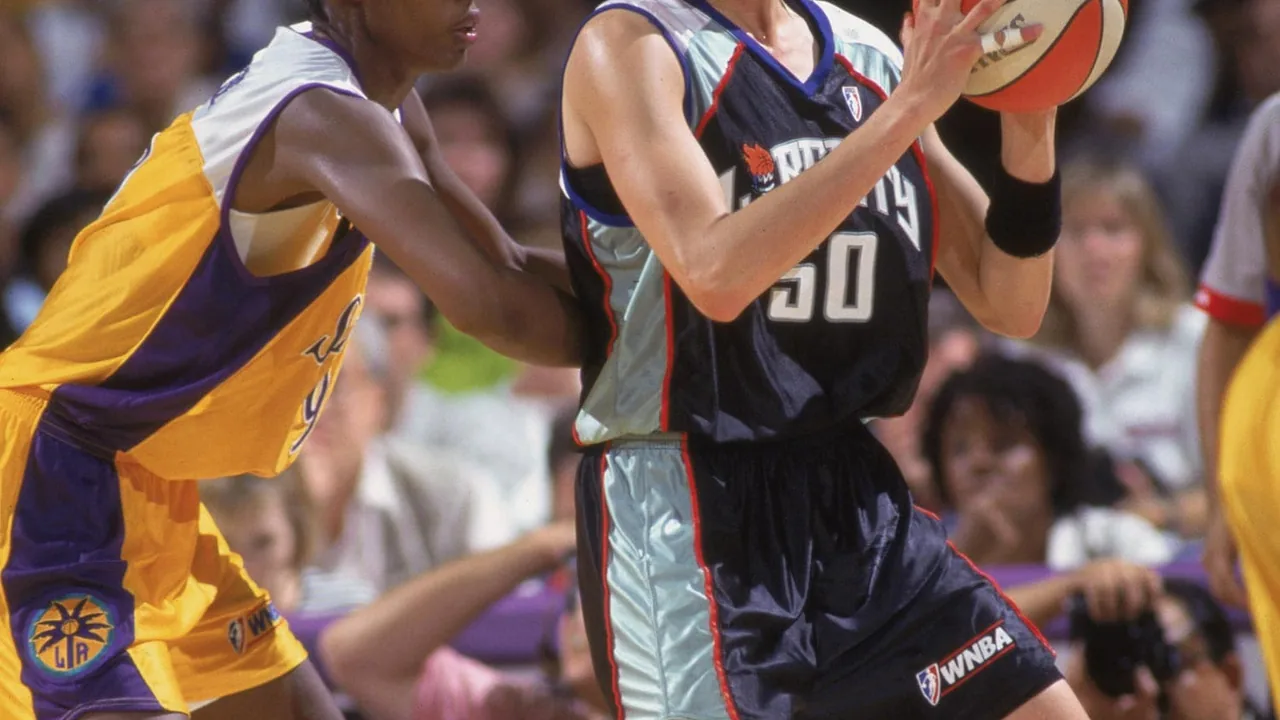
The first WNBA game was played on June 21, 1997, with New York visiting Los Angeles at the Great Western Forum. The Liberty won 67–57. Los Angeles guard Penny Toler scored the league's first basket. Those details appear in the league's own timeline and have remained the reference point for anniversary rematches and broadcasts ever since.
The matchup was a fitting opening stage: teams from the two largest U.S. media markets, with players who were already familiar to many college and Olympic basketball fans. The Sparks' history page records an attendance of 14,284. That crowd did not yet know which of the new franchises would become a champion, but it witnessed the start of a competition that would outlast many of the original names on the standings page. The WNBA also hosts a video of the first game for fans who want to see the early style of play directly.
Houston won the inaugural championship
New York won opening day, but Houston won the league's first championship on August 30, 1997, defeating the Liberty in the title game. Cynthia Cooper led the Comets' offense, and the team began a run of four straight championships from 1997 through 2000. That start shaped how fans understood early WNBA greatness: Houston was a complete team, with prominent stars and a style that other clubs had to solve quickly.
Do not confuse the first season's single title game with the later Finals formats. The competition expanded and changed its postseason structure over time. The enduring historical fact is that the Comets were the first champions and became the opening dynasty. Our greatest WNBA teams discussion looks at how Houston's run compares with later dynasties. The 1997 result also reminds us that an inaugural league season is more than a launch date: its first athletes and clubs immediately created records and rivalries for later teams to chase.
Expansion, relocation and the changing league map
The WNBA did not move in a straight line from eight original teams to 15 in 2026. It added clubs rapidly, reached 16 teams in 2000, lost some markets, relocated others and later entered a new expansion period. Fans sometimes see a familiar city or name and assume it represents an unbroken franchise. The timeline is easier to follow when we distinguish expansion, which adds a team, from relocation, which moves an existing franchise, and closure, which ends one.
Expansion from eight to 16 teams by 2000
The first expansion followed almost immediately. Detroit and Washington joined for the 1998 season, taking the league from eight to ten. Orlando and Minnesota arrived in 1999, bringing the total to 12. In 2000, Indiana, Miami, Portland and Seattle entered, raising the count to 16. Within four playing seasons, the league had doubled its original number of clubs. That meant more local fan bases, more roster places and a far broader set of opponents for the original eight.
Some of those additions became long-term anchors. The Washington Mystics, Minnesota Lynx, Indiana Fever and Seattle Storm remain recognizable 2026 clubs. Others did not last in their original form. The Orlando Miracle became the Connecticut Sun; the Miami Sol ceased operating after 2002. The first Portland Fire also ended after 2002, a point that matters because the 2026 Portland Fire use the same city and name as part of a new franchise, not as a continuation of that first team's seasons.
Expansion continued in later periods but at a different rhythm. Chicago began play in 2006, and Atlanta followed in 2008. The current map therefore contains a mix of clubs from the league's opening summer, early expansion waves, later new franchises and moved lineages. A team's present roster or arena tells only part of that story. The 2026 team-count guide answers the current numerical question; this timeline explains why the number has changed.
Franchises moved, folded and changed names
After the rapid early expansion, the league changed its ownership structure in 2002 to permit independently owned teams and markets without NBA teams. In the following period, some markets disappeared and others gained an existing club. The Orlando Miracle became the Connecticut Sun for 2003. The Utah Starzz moved to San Antonio, operated as the Silver Stars and later Stars, and moved again to Las Vegas ahead of 2018 to become the Aces. Utah is therefore part of the Aces' franchise history even though the current uniform, city and name are new.
The Dallas Wings offer a second clear example. That franchise began as the Detroit Shock, moved to Tulsa, then adopted the Wings identity in the Dallas area for the 2016 season. The Detroit championship banners belong to that franchise's historical record, although a present-day Dallas fan experiences a different city and club identity. Conversely, the Houston Comets' four straight titles are part of WNBA history, but there is no 2026 Comets roster to list beside Dallas or Las Vegas.
These distinctions help with practical fan questions. If you are tracing a record, draft history or championship lineage, follow the franchise through its moves. If you are planning a trip or choosing a current team to follow, use the present names and cities. And if an expansion announcement gives a city a team again, check whether it is a new franchise rather than assuming every old statistic carried over. The league's changing map reflects both enduring original clubs and several very different paths to survival.
A new growth era and the 2026 30th season
For many seasons after Atlanta's arrival, WNBA fans followed a 12-team league. The recent expansion wave has changed the scale again. Golden State entered in 2025, and Toronto and Portland followed in 2026, bringing the active total to 15 teams. The league describes 2026 as its 30th season, a fitting moment to compare the eight original markets with today's wider geographic reach.
This new period differs from the first expansion rush in one visible way: it reaches beyond the United States. Toronto's Tempo are the first WNBA franchise based outside the country. Portland also returns as a WNBA city, although the 2026 Fire are a newly awarded franchise rather than the same club that played from 2000 through 2002. Keeping that distinction clear preserves both parts of Portland's basketball history. The current team builds its own record while acknowledging the earlier city's place on the league map.
Golden State, Toronto and Portland expand the footprint
The Golden State Valkyries made their debut in 2025 as the league's 13th team. Toronto and Portland became the 14th and 15th franchises for 2026. The 2026 expansion draft illustrates what adding teams means in practice: new clubs assemble rosters from available players, then use free agency and the regular draft to build an identity. Expansion is therefore more than two pins added to a map; it creates new career opportunities and changes how existing teams protect and acquire talent.
The WNBA's 30th-season schedule announcement deliberately linked present to past. It set a Liberty–Sparks rematch on June 21, the anniversary of the league's inaugural matchup. By then, two new 2026 teams had joined and the league was playing 44 regular-season games per team. That contrast makes the growth concrete: the league still remembers its opening fixture while operating a broader season and reaching a Canadian market. For current team names and locations, use the 2026 WNBA team list; for announced plans beyond the current season, see the separate expansion outlook.
WNBA history questions fans still ask
A long league timeline can leave two simple questions unresolved: which of the founding teams can fans still watch today, and what does “30th season” mean when the first game took place in 1997? The answers depend on whether you are tracking names, franchise lineages or years elapsed since the opening game.
Which original WNBA teams are still playing?
Three original clubs still play under the same city and team name: the Los Angeles Sparks, New York Liberty and Phoenix Mercury. A fourth 1997 franchise survives through relocation and rebranding. The Utah Starzz moved to San Antonio and then to Las Vegas, where the franchise is now the Aces. This is why one list may say “three original teams remain” while another says “four original franchise lineages remain.” Both can be correct once the definition is stated.
Charlotte, Cleveland, Houston and Sacramento were also among the original eight, but those specific franchises do not have active 2026 teams. A new team in the same region would not automatically inherit an old club's full lineage. Today's complete league includes early expansion teams, moved franchises and the latest additions. Check the 2026 team list and cities for the current picture, and use historical names only when tracing the past.
Is 2026 the WNBA's 30th season or 30th anniversary?
The WNBA calls 2026 its 30th season. Count 1997 as season one, 1998 as season two, and the inclusive count reaches 30 in 2026. That is different from saying 30 full calendar years have passed since the inaugural game. The first game was on June 21, 1997, so its 30th calendar anniversary arrives on June 21, 2027. Sports leagues often celebrate a numbered season before the anniversary measured by elapsed years; the two dates are not a contradiction.
For a fan following the league now, the most useful historical habit is to label the time frame of each claim. “Original eight” means 1997 names. “15 teams” means the 2026 active league. “Thirty seasons” counts each season since 1997. And a player's historical team may differ from today's market because franchises moved. With those labels in place, even a complicated team timeline becomes much easier to follow. Our 2026 player ranking provides a separate snapshot of current-season standouts.
Sign in with Google to join the discussion.