
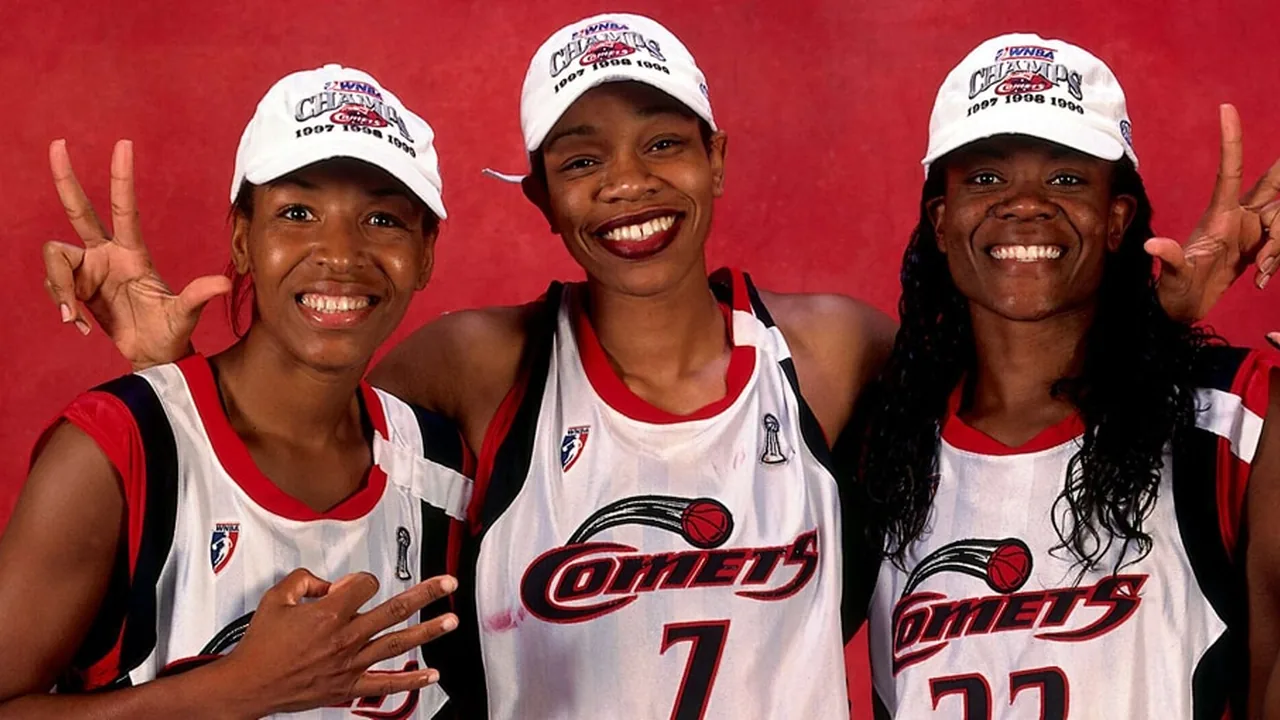
The 1998 Houston Comets are our pick for the best WNBA team of all time. They went 27-3, the highest single-season winning percentage in league history, won the championship, and captured the second title in a four-championship streak that no other WNBA franchise has matched. Cynthia Cooper, Sheryl Swoopes, and Tina Thompson gave Houston an extraordinary combination of scoring, defense, experience, and late-game control.
That answer needs one important distinction. “Best team” can mean the strongest roster in one season, while “greatest dynasty” measures excellence over several years. We give Houston both honors: the 1998 Comets own the best single-season case, and the 1997-2000 Comets remain the greatest dynasty because they won four championships in four consecutive seasons. Minnesota, Phoenix, Seattle, and Las Vegas produced credible challengers under longer seasons and more demanding playoff formats, so this is a reasoned historical ranking rather than an official league award.
If you are looking for the strongest teams right now rather than an all-time comparison, see our current 2026 WNBA power rankings. The ranking below focuses only on completed championship seasons and uses the same evidence for every candidate.
How we ranked the greatest WNBA teams
A championship is the entry requirement for this list, not the entire formula. We judged each team in five areas: regular-season dominance, postseason performance, quality and balance of the core roster, the ability to finish close games, and evidence that the season belonged to a larger stretch of contention. A brilliant runner-up can be historically important, but “best team” should still reward completing the championship job.
Win percentage matters more than raw wins because the schedule has expanded. Houston played 30 regular-season games in 1998, Phoenix played 34 in 2014, Las Vegas played 40 in 2023, and Seattle played only 22 at a neutral-site campus in 2020. Saying that 34 wins automatically beats 27 would reward calendar length rather than dominance. Point differential and efficiency add useful context: official Aces game notes identified a small group of teams that led the league in both offensive and defensive efficiency, and six of the seven earlier examples won the title.
Playoff difficulty also changed. The 1997 championship was one game, the 1998 Finals were best-of-three, later Finals became best-of-five, and the championship series expanded again in the modern era. A sweep through three rounds therefore tells us more than a bare label such as “undefeated.” We credit every champion under the rules it faced while recognizing that the number of elimination games was not constant. For an explanation of today's route, see the current WNBA playoff format.
Finally, this is a ranking of specific seasons. A later championship can strengthen a franchise's dynasty case, but it cannot add wins to an earlier roster. Readers who want current statistical leaders rather than a historical method can use our 2026 WNBA leaders and records. With those rules in place, Houston's 1998 combination of peak winning percentage, two-way separation, star power, and championship completion remains the most persuasive total résumé.
No. 1: 1998 Houston Comets — the best WNBA team of all time
Houston's 27-3 record produced a .900 winning percentage, still the top single-season mark in the historical tables checked for this ranking. The Comets did not simply edge opponents often enough to accumulate wins. Official league game notes credit them with a +12.7 average scoring margin and list them first in both offensive efficiency (104.1 points per 100 possessions) and defensive efficiency (86.7 allowed). Those figures describe a team that controlled both ends rather than depending on one overwhelming scorer.
The star structure was almost unfair. Cynthia Cooper drove the offense and won her second consecutive regular-season MVP, Sheryl Swoopes brought elite two-way pressure after missing much of the inaugural season, and Tina Thompson supplied size and scoring versatility. Kim Perrot, Janeth Arcain, and Tammy Jackson gave the famous trio trusted defenders and connectors. Cooper then won Finals MVP for the second straight year, an award she would claim in all four of Houston's championship seasons.
The postseason was not perfect, and that detail matters. Houston swept Charlotte in the semifinal but dropped Finals Game 1 to Phoenix. In Game 2, the Comets came back from a double-digit fourth-quarter deficit and won in overtime, then closed the best-of-three series in Game 3. That response is part of the case: the best regular-season team faced immediate elimination and still solved the series. It was the second title of the only four-peat in WNBA history.
The strongest objection is format. The 1998 schedule lasted 30 games, only four teams made the playoffs, and two short series required four wins rather than the longer route later champions faced. Houston's 2000 team actually went 6-0 through three playoff rounds and has a legitimate alternative claim. We still choose 1998 because no other champion has matched its regular-season winning percentage, its two-way numbers were elite for the era, and the same core proved the result was not a one-season accident.
Modern champions have to clear a different postseason path, explained in our WNBA playoff format guide. That context narrows Houston's advantage; it does not erase a 31-4 combined record or the championship. On peak performance plus repeatable greatness, the 1998 Comets remain our No. 1.
No. 2: 2013 Minnesota Lynx — a flawless playoff run
The 2013 Lynx supply the cleanest modern-format challenge to Houston. Minnesota went 26-8, finished first in the Western Conference for a third consecutive season, and then became untouchable. The Lynx swept Seattle 2-0, Phoenix 2-0, and Atlanta 3-0. A 7-0 postseason over three rounds leaves no series escape or winner-take-all coin flip to explain away.
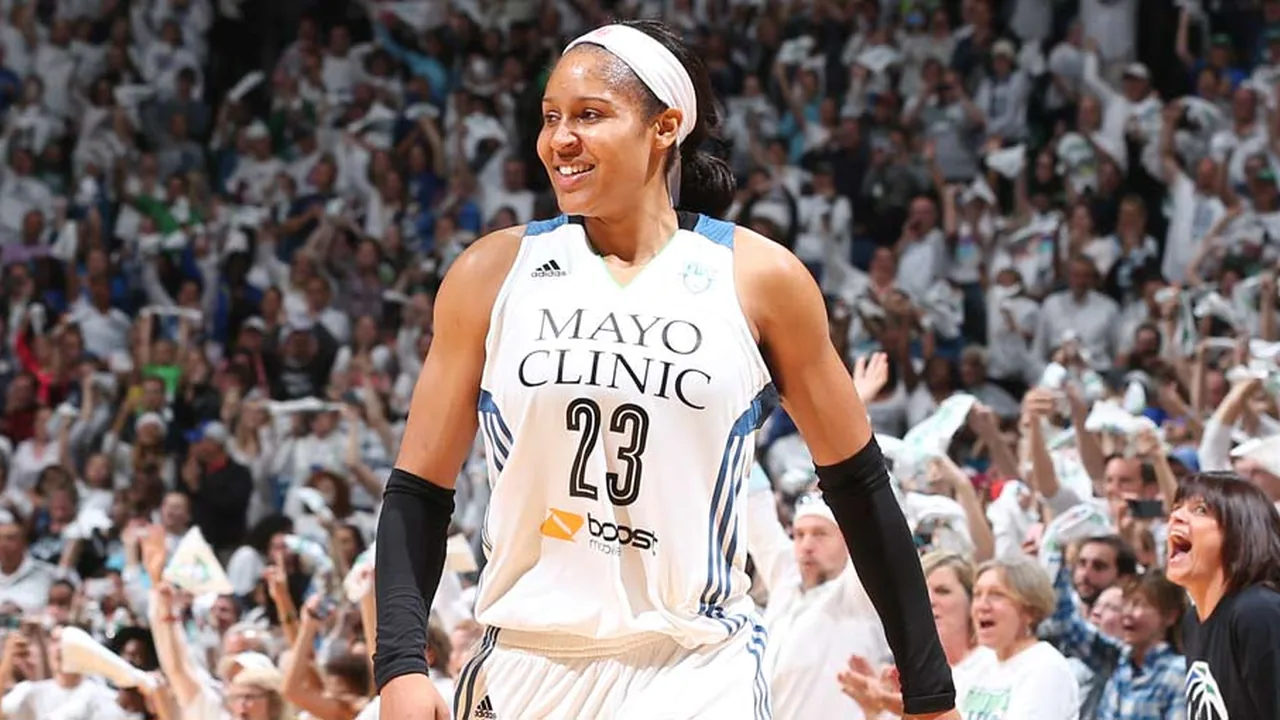
The margins make that perfect record even more impressive. The WNBA's season review says Minnesota won four of seven playoff games by double figures, including three victories by at least 23 points, and posted an average postseason margin of 15.4. The Lynx were not merely surviving a bracket. They were removing doubt from it, round after round, before completing a Finals sweep on Atlanta's floor.
Maya Moore was the centerpiece without making Minnesota one-dimensional. She scored 23 points in the 86-77 Game 3 clincher and averaged 21 points, five rebounds, and three assists in the Finals to earn the award. Seimone Augustus supplied another elite scoring option, Lindsay Whalen organized the attack, and Rebekkah Brunson did essential rebounding and defensive work. That continuity turned a great season into part of a larger run: this was Minnesota's second championship in three years, and the franchise eventually won four between 2011 and 2017.
Why not rank the Lynx first? Their .765 regular-season winning percentage trails Houston's .900 by a meaningful distance. The perfect seven-win postseason closes much of that gap, especially because it came under a best-of-five Finals structure, but Houston combined a greater regular-season separation with its own championship finish and an unmatched repeat record. Minnesota's case is strongest for the best postseason run, not necessarily the best complete season.
That distinction also keeps this historical analysis useful. Current dates and opponents change every day, so fans planning the next game should use the full WNBA schedule. The 2013 results are fixed: 26-8, 7-0, and a title won without a playoff loss.
No. 3: 2014 Phoenix Mercury — depth, defense and 29 wins
Phoenix owns the strongest 34-game regular season by a champion. The Mercury opened 6-3, then ripped off 16 consecutive wins from June 15 through July 29. They lost only two of their final 25 regular-season games and finished 29-5, an .853 winning percentage. At the time, only Houston's 1998 season and the Los Angeles Sparks' 28-4 seasons in 2000 and 2001 had produced better percentages.
The headline stars explain only part of the control. Diana Taurasi directed the offense and created late-clock answers, while Brittney Griner's reach changed what opponents could attempt at the rim. Penny Taylor linked the lineup as a scorer, passer, and defender. Official historical game notes place Phoenix at 106.4 points scored and 94.1 allowed per 100 possessions, one of the rare teams to lead the league in both offensive and defensive efficiency and then win the championship.
The playoff road included a real test. Phoenix swept Los Angeles, then split the first two Western Conference finals games with defending champion Minnesota. Back at home for Game 3, Taurasi scored 31 and Griner added 22 in a 96-78 win. That mattered because Minnesota was not a ceremonial obstacle; it was the reigning champion and the defining rival of the era. Phoenix then beat Chicago in three straight Finals games.
The Finals sweep combined dominance with one demanding closeout. Phoenix won the first two games by 21 and 29 points. Game 3 was tied at 82 late before Taurasi scored 14 of her 24 points in the fourth quarter and converted a three-point play with 14 seconds remaining. The Mercury finished the championship on the road, and Taurasi earned her second Finals MVP.
Phoenix ranks behind 2013 Minnesota because the Mercury dropped one playoff game and the Lynx did not. It ranks behind Houston because .853 remains short of .900. Yet the 2014 Mercury have perhaps the most balanced résumé on this list: 29 wins, a 16-game streak, elite performance on both ends, only one home loss across the regular season and playoffs, and a title run that went through the previous champion. Any ranking driven more heavily by schedule length or two-way depth could reasonably move Phoenix higher.
No. 4: 2020 Seattle Storm — bubble-season perfection
Seattle's 2020 résumé compresses extraordinary dominance into the strangest season on this list. The WNBA played a 22-game regular season at IMG Academy in Bradenton, Florida, without normal home courts or travel. Seattle tied Las Vegas for the league's best record at 18-4, earned a double bye, and then did not lose again. The Storm swept Minnesota in the semifinals and Las Vegas in the Finals for a 6-0 postseason.
The series scores show that the run was more than a short schedule producing a small sample. Minnesota pushed Game 1 to the final possession, but Seattle won 88-86, then took the next two 89-79 and 92-71. Against the Aces, the margins grew: 93-80, 104-91, and 92-59. The 33-point closeout remains one of the starkest championship-game score lines in league history.
Breanna Stewart was the matchup no opponent solved. She opened the Finals with 37 points and 15 rebounds, while Sue Bird set a WNBA playoff and Finals record with 16 assists. Seattle then recorded 33 assists in Game 2, a Finals record at the time. Stewart finished the three-game series averaging 28.3 points and 7.7 rebounds on 63% shooting, scored 26 in the clincher, and collected her second Finals MVP.
The larger franchise story raises the achievement without changing the season's numbers. Bird won her fourth championship 16 years after her first, and Seattle joined Houston and Minnesota as the only four-title franchises at that point. Stewart and Bird had both missed the 2019 season, so their return restored the core of the 2018 champion and immediately produced another title.
Ranking Seattle fourth is a judgment about sample size, not an asterisk. Every contender operated under the same 2020 conditions, and a 24-4 combined record is overwhelming. But 22 regular-season games provide fewer chances for injuries, road fatigue, and extended slumps to test a roster than 30, 34, or 40 games. The Storm could only dominate the competition and format they were given; they did exactly that. Fans comparing that best-of-five title route with today's structure can consult the 2026 WNBA Finals guide.
No. 5: 2023 Las Vegas Aces — the modern offensive standard
Las Vegas went 34-6 in 2023, setting a then league record for wins while matching Phoenix's .850-range standard across a longer, 40-game test. Becky Hammon's offense created exceptional spacing around A'ja Wilson, with Chelsea Gray controlling the middle of possessions and Kelsey Plum and Jackie Young stretching defenses. The Aces could score early, punish switches, or let Wilson settle a possession without becoming predictable.
The postseason record was 8-1. Las Vegas swept Chicago 2-0 and Dallas 3-0, then took the first two Finals games from New York. The Liberty won Game 3, and injuries removed Gray and starting center Kiah Stokes from Game 4. That adversity supplies a different kind of evidence than a clean sweep: the Aces had to win on the road, against the league's other superteam, without their point guard and a key interior defender.
New York led by 12 early in the third quarter, but Las Vegas recovered and carried a 53-51 edge into the fourth. The Aces led 70-64 with 1:27 left, did not score again, and survived as the Liberty's final attempt missed. The 70-69 result made Las Vegas the first repeat WNBA champion in more than two decades. Wilson earned Finals MVP, while Alysha Clark's veteran depth and the remaining starters' defensive execution made the short-handed closeout possible.
The 2025 title strengthens the wider Las Vegas dynasty case. Hammon's Aces have won three championships in four seasons—2022, 2023, and 2025—but that later trophy does not retroactively improve the 2023 team's 42-7 combined record. It shows that the organizational core could retool, absorb a disappointing 2024, and return to the top. That is relevant in the dynasty discussion, not in the calculation of one season.
Why fifth? The 34 wins are partly a product of the longest schedule among our five candidates, and the Aces' .850 percentage trails Houston and Phoenix. They also lost one playoff game, unlike Minnesota and Seattle. Yet this placement is close: a reader who gives more weight to modern depth, longer series, and the difficulty of repeating could rank Las Vegas first or second. For us, the 2023 Aces are the clearest modern offensive benchmark and the best proof that this list cannot be settled by nostalgia.
Greatest dynasty versus greatest single-season team
A single-season ranking asks which roster produced the strongest completed campaign. A dynasty ranking asks whether a franchise could preserve championship quality through injuries, roster changes, and repeated playoff scouting. Those questions overlap, but they do not have to produce the same answer. Houston happens to lead both for us because its highest peak occurred in the middle of the league's only four-peat.
| Team era | Titles | Defining achievement | Important context |
|---|---|---|---|
| Houston Comets, 1997-2000 | 4 | Only four consecutive titles in WNBA history | Shorter schedules and playoff series |
| Minnesota Lynx, 2011-2017 | 4 | Six Finals trips and four titles in seven seasons | No back-to-back championship |
| Seattle Storm, 2004-2020 | 4 | Four titles across multiple roster eras | Long gaps make this a legacy more than one continuous dynasty |
| Las Vegas Aces, 2022-2025 | 3 | Three titles in four seasons, including a repeat | Active era can still add to its case |
Houston's advantage is uninterrupted command. The Comets never entered a WNBA season without eventually lifting the trophy until their fifth year, and the Cooper-Swoopes-Thompson core was intact for all four championships. Minnesota offers the best counterargument: four championships and six Finals appearances across seven seasons under a longer postseason structure show a breadth of contention Houston was never asked to match.
Seattle's four trophies demonstrate franchise longevity rather than one continuous reign. Sue Bird connected championships 16 years apart, first with Lauren Jackson and later with Breanna Stewart, an achievement unlike any compact four-year run. Las Vegas owns the strongest recent dynasty: a repeat in 2022-23, a rebound from the 2024 semifinal loss, and another championship in 2025.
So the concise answer is this: choose the 1998 Comets for the best single season and the 1997-2000 Comets for the greatest uninterrupted dynasty. Choose Minnesota if your definition gives more weight to repeated Finals under a mature playoff format, and keep Las Vegas in the debate because its era is not finished. The categories explain disagreement better than one unsupported GOAT label.
Frequently asked questions about the greatest WNBA teams
Which WNBA teams have won the most championships? Through the completed 2025 season, the Houston Comets, Minnesota Lynx, and Seattle Storm share the franchise record with four championships each. Their paths were very different: Houston won four consecutively, Minnesota won four across seven seasons, and Seattle won four across a 17-season span. Las Vegas is next among the leading current cases with three titles from 2022 through 2025.
Has any WNBA team won four championships in a row? Yes. Houston won the first four league championships, from 1997 through 2000. No other WNBA franchise has three-peated. Los Angeles repeated in 2001 and 2002, and Las Vegas became the next repeat champion in 2022 and 2023, but neither extended the run to a third straight title.
What is the best regular-season record in WNBA history? By winning percentage, the 1998 Comets' 27-3 record remains the standard at .900 in the historical tables checked on September 3, 2026. Raw win totals can be larger in longer seasons: the 2023 Aces went 34-6, but their .850 percentage was slightly below Phoenix's 29-5 (.853) in 2014 and well below Houston's mark.
Which WNBA champions went undefeated in the playoffs? Under series-based postseason formats, Houston in 2000 and Los Angeles in 2002 went 6-0; Seattle in 2010 and Minnesota in 2013 went 7-0; and Seattle went 6-0 in 2020. Houston also went 2-0 in the 1997 bracket, but those were two single-elimination games, so it should not be treated as equivalent to a three-round sweep.
What is the best modern WNBA dynasty? Minnesota has the broadest post-2000 résumé with four titles and six Finals appearances from 2011 through 2017. If “modern” means the most recent compact championship run, Las Vegas leads: the Aces won in 2022, 2023, and 2025. The better choice depends on whether the priority is more total titles and Finals trips or three championships in only four seasons.
Can the answer change? Yes. Historical results will not change, but a current franchise can add titles and alter the dynasty comparison. We will recheck this ranking after each Finals. For confirmed dates and the live championship path rather than historical debate, use the latest WNBA Finals guide and the site's schedule tools.
Sign in with Google to join the discussion.