
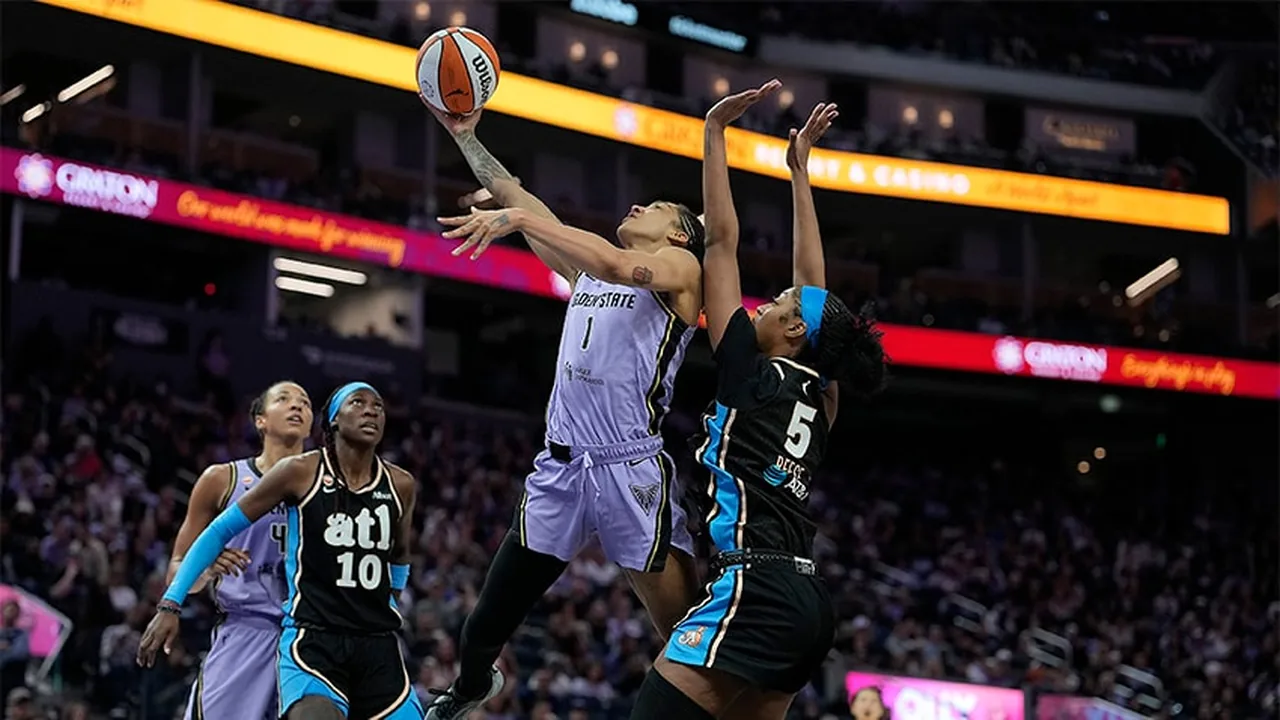
Who holds the WNBA's major all-time records? For regular-season career totals, Diana Taurasi leads in points with 10,646, Tina Charles leads in rebounds with 4,262, and Sue Bird leads in assists with 3,234. Those figures answer three different statistical questions. They also use a different timespan from a single-game high or the most rebounds in one season. This guide, checked on October 10, 2026, keeps those boundaries visible as it turns to the three-way scoring tie and the records that changed during 2026.
Who leads the WNBA in career points, rebounds and assists?
The WNBA's official all-time milestone report names the leaders in the three traditional counting categories. Each number adds up eligible regular-season contributions over an entire WNBA career. A 30-point night contributes 30 to a player's career points; it is not a separate kind of point. Likewise, a rebound or assist in one game becomes part of a multi-year total when the league records that game.
| Category | Leader | Career total |
|---|---|---|
| Points | Diana Taurasi | 10,646 |
| Rebounds | Tina Charles | 4,262 |
| Assists | Sue Bird | 3,234 |
Taurasi's 10,646 points came across 565 regular-season games. The scale of that total speaks to both scoring ability and a long playing career. It does not tell you how many points she averaged in a typical game; for that, you need a rate with games played as the denominator. It also should not be silently combined with playoff scoring. The league's all-time statistics view has a regular-season filter precisely because competition scope matters.
Charles owns the rebounding line at 4,262. She collected those boards by gaining possession after missed shots over a career, not in one season or one exceptional night. The milestone article was written ahead of the 2026 season and marks her as active. The league later published a May 5, 2026 retirement statement, so that status label is no longer current. The accumulated record remains the same; the publication date explains the discrepancy. An older article can preserve a correct number while carrying an obsolete description of the player.

Bird's 3,234 assists measure completed scoring passes credited over her WNBA regular-season career. Assists can be a useful signal of playmaking and longevity, but they still depend on a teammate finishing the shot. Her career number is unrelated to the record for most assists in a single game, which belongs to another player and appears later in this guide. Calling both an “assists record” without the timespan invites confusion.
Career totals are not an automatic answer to “best player ever,” either. Different positions and eras offer different scoring, rebounding and passing opportunities, and a title is won by a team. If you are comparing franchise success instead, the site's all-time team debate asks a different question. For these three individual columns, the practical answer is Taurasi, Charles and Bird, with the word career and the regular-season scope attached to every number.
Who shares the WNBA single-game scoring record?
The individual scoring high for one WNBA regular-season game is 53 points, shared by Liz Cambage, A'ja Wilson and Marina Mabrey as of this October 2026 check. Each scored 53 in a different game. This is not a combined total and there is no sole current holder of the mark. Search results can be confusing because a story written after the first of those games naturally called Cambage the record setter, while a 2023 story called Wilson a record-tier; a newer 2026 game added Mabrey to the same line.
One-game records reward a peak performance, while the career points total above rewards production across hundreds of games. A player can hold the one-night high without leading the all-time career points column. The scoring tie is therefore best understood as a separate answer to a separate fan question: what is the most one player scored on a single official WNBA night? The league's final game accounts give the players, opponents, dates and scores that make the answer checkable.
Three separate 53-point games
Liz Cambage began the 53-point line on July 17, 2018. Playing for the Dallas Wings against the New York Liberty, she scored 53 in a 104–87 win. The WNBA's detailed game analysis says she made 17 of 22 field-goal attempts. That efficiency is part of why the performance became more than a large box-score number: it came on a relatively small number of shots for such a scoring total. At that point, 53 was a new league high; the later ties had not yet happened.
A'ja Wilson equaled it on August 22, 2023. Her Las Vegas Aces defeated the Atlanta Dream 112–100 while Wilson scored 53. The Aces' official recap identifies the total as record-tying and reports 16-for-23 shooting from the field and 20-for-21 at the foul line. Those details show a different route to the same scoring endpoint. The 112 is Las Vegas's team score; Wilson personally supplied 53 of those points, which is the part relevant to this individual record.
Marina Mabrey matched the high on June 25, 2026. Toronto Tempo beat the Los Angeles Sparks 125–97, and the WNBA final game page records Mabrey's 53. The page explicitly names the Cambage and Wilson games as the two earlier benchmarks she reached. A later league power ranking also describes the mark as shared among all three. That is the update an older “single-game points record” article may miss.
It is tempting to turn a three-way tie into a ranking of which night was “best,” but 53 itself cannot choose between them. The matchups, shooting mixes, team scores and seasons were different. A fan can appreciate those contexts without pretending the official points record has an undisputed first, second and third place among 53-point games. The record line simply carries three names until someone scores more in a qualifying game or the league corrects an official score.
What are the single-game rebound and assist highs?
For individual WNBA regular-season games, the rebound high is 26 by Angel Reese and the assist high is 18 by Courtney Vandersloot. These are different basketball actions and different games. A rebound is credited for securing the ball after a missed shot; an assist is credited to a passer when a teammate converts the ensuing scoring play under the league's rules. Reading the labels is as important as reading the numbers.
Reese took 26 rebounds for the Atlanta Dream at the Los Angeles Sparks on August 24, 2026. The WNBA's final game account calls it a new one-game league mark and reports Atlanta won 78–71. The previous high was Chamique Holdsclaw's 24 in 2003. Two extra boards may sound small in isolation, but reaching 26 in one game requires repeated positioning, missed-shot chances and successful possessions. Reese also had 11 points in that game, which is separate from the rebound record.
The same August night pushed Reese past the then-current season rebounds record. That does not mean 26 and the season number are competing entries. The 26 boards occurred within one game; every rebound in that game also contributes to the cumulative 2026 season total discussed below. The final 2026 season sum was higher than the number displayed in the August game recap, because more games followed. Source dates explain the difference without changing what happened at Los Angeles.
Vandersloot's 18 assists came for the Chicago Sky in a 100–77 victory over the Indiana Fever in 2020. The WNBA game report describes her first matching the previous 16-assist mark and then passing it with later scoring passes. An assist record highlights her decisions and teammates' shot-making together. Her 18 belong to one Chicago game; Sue Bird's 3,234, shown in the career table, reflect an entire regular-season career. One player can own a one-night peak without owning the largest career total.
It is also worth specifying individual. A 2026 Chicago Sky retrospective celebrates the club's 38 assists in one game as a league-wide team record. Thirty-eight team assists are not evidence that a single player surpassed Vandersloot's 18. A team box score adds the assists of multiple players. If you are following a new matchup and want to inspect its final team and player lines, the site's WNBA scores view gives you a date-based starting point; then check the league's official final box score before announcing a new individual record.
Putting these peaks side by side shows why an all-time records article cannot be a single sorted list of numbers. Fifty-three points, 26 rebounds and 18 assists measure different work on the court. Their common feature is that each occurred in one WNBA regular-season game. The category, person, opponent and game date make each claim useful to a fan who wants to revisit the play or compare a new performance with the established high.
Which 2026 milestones changed longer-span records?
Two 2026 stories belong beside the one-game marks but use longer clocks. Angel Reese built a season-long rebounding total over the Atlanta Dream's regular-season schedule. Brittney Griner's blocks, accumulated across her career, moved her ahead of the previous leader. Both made the record book, yet their totals cannot be compared like two entries in the same contest. The right question for Reese is “most rebounds in one season?”; for Griner it is “most blocked shots across a career?”
The timing of a report matters differently for these two cases. Reese's final 2026 season tally can be reported after that regular season ended. Griner's 878th block identifies the exact moment she passed the old career mark, but an active player's career number can rise on subsequent blocks. A headline that says “record broken” may describe a completed season figure or a moving career leaderboard. Fans should read the period before saving the number.
Reese's 521-rebound season
Reese finished the 2026 WNBA regular season with 521 rebounds, becoming the first player to reach 500 in a single season, according to the league's October 1 award report. The Atlanta Dream's own award release independently describes the season rebounding record. Because the 2026 regular season is over, 521 is a completed season total rather than the August in-progress number from the game in Los Angeles.
Within her 521 were 206 offensive rebounds, also a new season mark. Offensive boards are chances recovered after her team misses; defensive boards come after opponents miss. The 206 are already part of the 521, so adding them would double-count the same possessions. The WNBA also credited Reese with 32 double-doubles and an average of 12.1 rebounds per game across 43 games. A double-double is a game with double figures in two statistical categories; it tracks repeated production rather than the sum of all rebounds.
Her record 26-rebound game at Los Angeles helped create the 521 total. It should not be listed as a fourth, unrelated pile of rebounds. One game can break a one-game record and contribute to a season record at the same time. Reese also won the 2026 Defensive Player of the Year award, which recognizes broader defensive impact. The award and the numeric rebounding records are related stories but distinct claims: a vote for defensive excellence is not itself a new rebounding statistic.
Atlanta's later playoff tracker can show postseason games involving Reese and the Dream, but those games do not extend her 2026 regular-season count beyond 521. The cover photograph of Reese in Dream uniform belongs to that 2026 season context. Readers comparing her with an older season should select the same competition and note how many games each player had available.
Griner's career blocks takeover
Brittney Griner changed a career list, not a single-season one. While playing for the Connecticut Sun, she rejected Chicago Sky center Kamilla Cardoso for her 878th regular-season career block. A report hosted by the WNBA identifies that play as the one that moved her past Margo Dydek, who held the previous mark with 877. The league's June 22 game recap also marks the 878th as her fourth block of that game.
The 878 figure is the takeover point, not necessarily Griner's end-of-season or current career total. Each eligible block afterward could increase it. A milestone account tells the story of the opponent, shot and date when first place changed; a current all-time table is better for an up-to-the-minute total. That distinction prevents a historic headline from turning into a stale leaderboard entry as soon as the player returns to the court.
Blocks and rebounds are both defensive contributions, but they record different events. A block changes an opponent's shot; a rebound secures a miss. Griner did not take over Reese's season rebounds line, and Reese's Defensive Player of the Year honor does not imply she led career blocks. Their 2026 achievements make more sense together as a reminder that every record needs a category and a timescale attached.
How can fans verify a WNBA record claim?
Start by turning the claim into a complete question. “Who has the WNBA record for rebounds?” is too broad; “who has the most individual rebounds in one regular-season game?” points to Reese's 26, while “who has the most regular-season career rebounds?” points to Charles's 4,262. Once you have the statistic, time span and competition, an official record table or final game page can answer it. Without those qualifiers, two correct pages may appear to disagree while actually measuring different things.
The league's all-time leaders tool exposes a Regular Season filter and columns for games played, points, rebounds and assists. Check the filter before copying a number. A postseason game does not quietly become part of a regular-season career total. The site's 2025 Finals recap, for example, discusses a completed title series; it is a useful postseason story, not a source for Taurasi's regular-season points. Never combine the two competitions unless a source explicitly says it has calculated a combined figure.
Also decide whether you need a total or an average. Reese's 521 boards tell you how many she collected across her 2026 regular season; 12.1 rebounds per game describes a rate. The season total reflects both her typical production and how many games she played. Likewise, Taurasi's 10,646 points describe career accumulation across 565 games, not the number of points she scored on an ordinary night. A comparison between players is meaningful only after the columns match.
Next, read dates. The WNBA's career-leaders story said it was written ahead of the 30th season and marked Charles as active. The later May retirement announcement supersedes that status without erasing the correct rebound total. The June 2026 Toronto game added Mabrey to a scoring record that older Cambage and Wilson articles could not have included. Rather than dismiss the older pages, keep them as accounts of the mark when each game occurred and use the newer final account for the present list of tied leaders.
For a game that just ended, find its date in the WNBA schedule, open the official final box score, and look at the individual player line. A search snippet might say “record night” without specifying team versus individual or single-game versus season. The Chicago Sky's 38 team assists and Vandersloot's 18 individual assists demonstrate that hazard. A final box score, an official record release and the date of each source give a fan enough context to verify the claim before passing it along.
Keeping a simple note with category, period, competition, player, date and link makes a record shareable. If the leader is still active, revisit the career table after another game or season; a milestone such as Griner's 878th block establishes when she took first place, not where her total must stay forever. Historical records are more enjoyable when the numbers are attached to the real play and the correct moment in time.
Sign in with Google to join the discussion.