
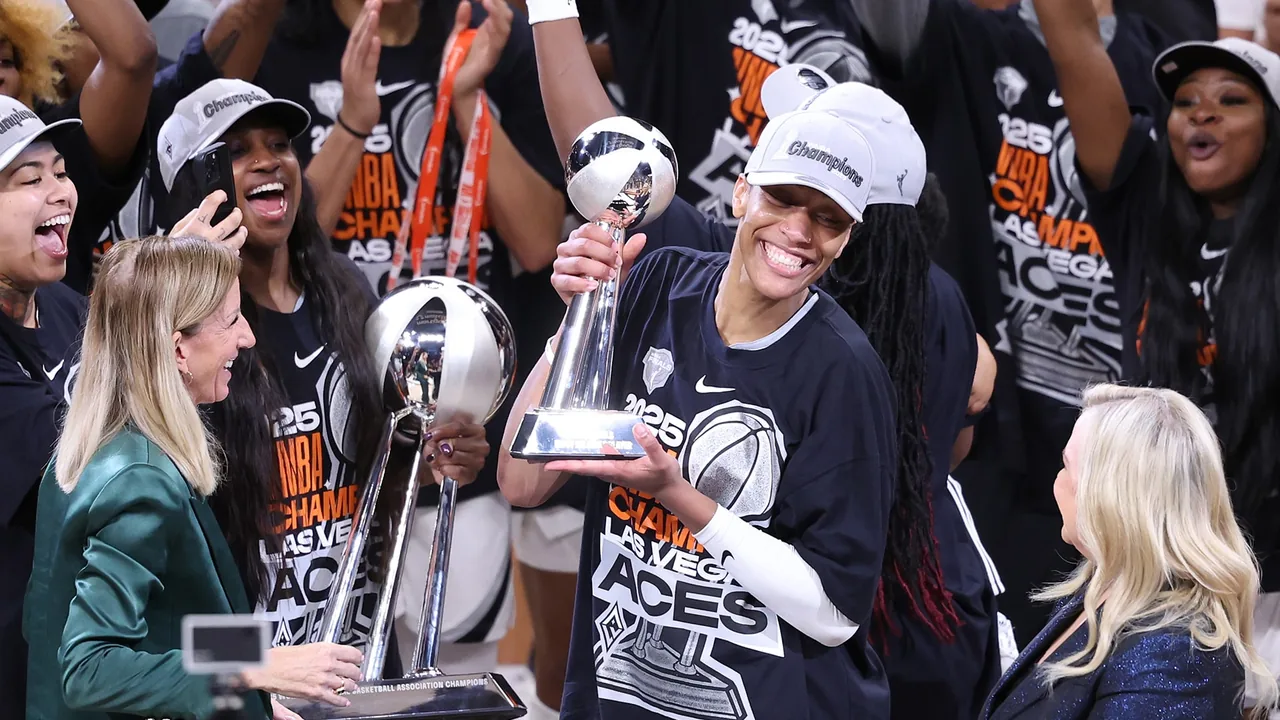
Updated October 10, 2026. The WNBA has crowned 29 champions across 29 completed seasons, from the Houston Comets in 1997 to the Las Vegas Aces in 2025. Houston, Minnesota and Seattle are tied for the most championships with four apiece. The 2026 Finals have not begun as of this update, so there is no 2026 winner to add. The list below follows the WNBA's official all-time champions table and keeps historical franchise names as they appeared when the titles were won.
Every WNBA champion from 1997 through 2025
The champion won that season's championship round; the runner-up reached the Finals but did not win the title. The Finals MVP column names the player honored for that series, not necessarily the league's regular-season MVP. Read the table from newest to oldest to see the current title holders first, or start in 1997 to trace how the league began.
| Year | Champion | Runner-up | Finals MVP |
|---|---|---|---|
| 2025 | Las Vegas Aces | Phoenix Mercury | A'ja Wilson |
| 2024 | New York Liberty | Minnesota Lynx | Jonquel Jones |
| 2023 | Las Vegas Aces | New York Liberty | A'ja Wilson |
| 2022 | Las Vegas Aces | Connecticut Sun | Chelsea Gray |
| 2021 | Chicago Sky | Phoenix Mercury | Kahleah Copper |
| 2020 | Seattle Storm | Las Vegas Aces | Breanna Stewart |
| 2019 | Washington Mystics | Connecticut Sun | Emma Meesseman |
| 2018 | Seattle Storm | Washington Mystics | Breanna Stewart |
| 2017 | Minnesota Lynx | Los Angeles Sparks | Sylvia Fowles |
| 2016 | Los Angeles Sparks | Minnesota Lynx | Candace Parker |
| 2015 | Minnesota Lynx | Indiana Fever | Sylvia Fowles |
| 2014 | Phoenix Mercury | Chicago Sky | Diana Taurasi |
| 2013 | Minnesota Lynx | Atlanta Dream | Maya Moore |
| 2012 | Indiana Fever | Minnesota Lynx | Tamika Catchings |
| 2011 | Minnesota Lynx | Atlanta Dream | Seimone Augustus |
| 2010 | Seattle Storm | Atlanta Dream | Lauren Jackson |
| 2009 | Phoenix Mercury | Indiana Fever | Diana Taurasi |
| 2008 | Detroit Shock | San Antonio Silver Stars | Katie Smith |
| 2007 | Phoenix Mercury | Detroit Shock | Cappie Pondexter |
| 2006 | Detroit Shock | Sacramento Monarchs | Deanna Nolan |
| 2005 | Sacramento Monarchs | Connecticut Sun | Yolanda Griffith |
| 2004 | Seattle Storm | Connecticut Sun | Betty Lennox |
| 2003 | Detroit Shock | Los Angeles Sparks | Ruth Riley |
| 2002 | Los Angeles Sparks | New York Liberty | Lisa Leslie |
| 2001 | Los Angeles Sparks | Charlotte Sting | Lisa Leslie |
| 2000 | Houston Comets | New York Liberty | Cynthia Cooper |
| 1999 | Houston Comets | New York Liberty | Cynthia Cooper |
| 1998 | Houston Comets | Phoenix Mercury | Cynthia Cooper |
| 1997 | Houston Comets | New York Liberty | Cynthia Cooper |
Several patterns become visible without treating all 29 Finals as the same kind of event. Houston won each of the first four seasons. Los Angeles followed with consecutive titles in 2001 and 2002. Minnesota spread four wins between 2011 and 2017, while Seattle's four stretch from 2004 through 2020. More recently, Las Vegas took three of the four completed titles from 2022 through 2025, with New York's first championship interrupting that run in 2024. Those are franchise totals, not totals for one unchanging roster.
The most recent line deserves its own context. Las Vegas defeated Phoenix in the 2025 Finals, with A'ja Wilson named Finals MVP; our 2025 Finals review covers that series in more detail. A title list can answer who won, but it does not explain every game, injury, roster decision or coaching adjustment. That is why the next sections focus on the title patterns fans most often compare, then explain how old team names and changing formats affect the table.
Which franchises have won the most WNBA titles?
Houston, Minnesota and Seattle share the record at four championships each through the completed 2025 season. That is a three-way tie, so naming just one as the all-time leader would leave out two clubs. Las Vegas, Los Angeles, Phoenix and the Detroit Shock each have three in the official annual list. The tie also comes from three very different competitive paths: four straight to start the league, four across seven seasons, and four spread across sixteen seasons. Counting the seasons is straightforward; deciding which run was greatest is a separate judgment, explored in our all-time team comparison.
Houston's opening four-peat
The Comets won in 1997, 1998, 1999 and 2000. No other franchise in the completed list matched four consecutive WNBA titles. Houston set the first standard for the league before a later team even had a championship banner to chase. Its leading core included Cynthia Cooper, Sheryl Swoopes and Tina Thompson, as the WNBA's account of early dynasties describes. The Finals MVP column is unusually consistent in this stretch: Cooper earned the honor in all four seasons. That individual pattern should not be confused with a claim that every role player, opponent or format stayed the same.
The 1997 championship was especially different from what modern fans expect. Houston defeated New York in the league's inaugural championship game, a single winner-take-all contest. Later Finals used series formats, so the four titles were not four identical journeys. The 1998 opponent was Phoenix; New York returned as runner-up in 1999 and 2000. Looking across the rows explains both the dynasty and how often the Liberty were already near the title in the WNBA's first years. The Houston franchise is no longer an active team, but its championships remain part of league history. A current team directory cannot replace that historical name in the title record.
Minnesota's four titles in seven seasons
Minnesota's victories came in 2011, 2013, 2015 and 2017. Each fell in an odd-numbered year, but the pattern was not automatic: the Lynx still had to earn each return trip and close out each Finals. The league's 2017 report notes that the fourth title arrived after Minnesota had lost a tight 2016 Finals to Los Angeles. A rematch against the Sparks, this time ending in a deciding Game 5 victory, made the fourth banner more than a continuation of an unbeaten streak. It showed the same franchise recovering from a championship loss.

The individual awards also moved across the core. Seimone Augustus was Finals MVP in 2011, Maya Moore in 2013 and Sylvia Fowles in both 2015 and 2017. The names help a fan understand how several elite players contributed to a longer run rather than one player monopolizing every season's story. Minnesota's four titles tie Houston's total without matching Houston's four-year sequence. That distinction matters when someone asks which WNBA team has the most championships: the answer is about count, while the shape of the dynasty is another question.
Seattle's four titles across three eras
Seattle won in 2004, 2010, 2018 and 2020. The Storm's WNBA team record confirms all four championship years. A 16-year gap separates the first and fourth, so the club's total represents sustained organizational success across changing groups rather than one uninterrupted peak. The first title came with Sue Bird and Lauren Jackson among the key figures. Jackson was Finals MVP in 2010, while Breanna Stewart earned that award in 2018 and 2020. Betty Lennox won it in the first title season, 2004.
Seattle's path is a useful counterexample to treating a dynasty as necessarily consecutive championships. A club can remain relevant, remake its roster and return to the summit years later. The Storm's 2018 and 2020 teams were not carbon copies of 2004, just as the championship trophy was not won under one unchanging format throughout the league's history. For a fan comparing all-time totals, Seattle is level with Houston and Minnesota. For a fan comparing the experience of watching those teams, the first Seattle title and the Stewart-era titles belong to noticeably different moments in the WNBA's development.
How the championship map changed after 2020
The table's most recent stretch includes new champions and a short run of Aces titles. Washington's 2019 championship and Chicago's 2021 win expanded the group of franchises with a banner; New York finally joined them in 2024. Las Vegas built a different story, winning in 2022 and 2023, losing the title to New York in 2024, then taking it back in 2025. Looking only at the latest champion can obscure those alternating breakthroughs. Looking only at all-time totals can obscure that many fans saw a franchise win for the first time only recently.
New winners in Chicago, Las Vegas and New York
Chicago defeated Phoenix in 2021 for the Sky's first title, with Kahleah Copper named Finals MVP. The next two completed seasons belonged to Las Vegas: the Aces beat Connecticut in 2022, when Chelsea Gray earned Finals MVP, and New York in 2023, when A'ja Wilson received it. That made Las Vegas the first repeat champion since the 2001–02 Los Angeles Sparks, according to the league's historical account. The consecutive Aces wins are one reason recent searches often start with Las Vegas, even though Houston, Minnesota and Seattle still lead the all-time franchise count.
New York's 2024 win over Minnesota is a reminder of the difference between Finals appearances and championships. The Liberty had reached the last round repeatedly, including in 1997, 1999, 2000, 2002 and 2023, but their first title came in 2024. Jonquel Jones was the Finals MVP. The runner-up rows are not consolation championships; they show how close New York had been before finally converting an appearance into a banner. Washington's 2019 first title offers another example of a club reaching the top after previously coming up short in a Finals, against Seattle in 2018.
Las Vegas then won again in 2025, defeating Phoenix. The WNBA's 2025 Finals account describes that win as the Aces' third championship in four seasons and identifies Wilson as both league and Finals MVP. The 2024 Liberty title interrupted the streak, so "three in four" is the precise phrase; "four straight" or even "three straight" would be wrong. The 2025 series was also the first Finals played as best of seven. That format change is another reason to compare championship eras thoughtfully: a 4-0 Finals sweep in 2025 and a 2-0 Finals win from an early season both earn one title, but the path to those titles differs.
Why the 2026 champion is still undecided
As of October 10, 2026, the official playoff bracket shows the Atlanta Dream and Golden State Valkyries as finalists. Game 1 is scheduled for October 17. Neither a high seed nor a semifinal sweep is an awarded championship, so a 2026 row would be premature. The article's title-count statements also remain anchored to completed seasons through 2025. Fans can follow our current playoff bracket for the developing matchup and the Finals schedule guide for dates and series structure.
Once a team actually wins four Finals games, the annual table should gain its 2026 champion, runner-up and Finals MVP after those are officially confirmed. The franchise counts would then be recalculated. That is a small update to an evergreen reference, but it is a consequential one. A visitor who finds a winner listed before the final game has no way to know which other rows are trustworthy. Until the competition decides the title, the 2025 Aces remain the last completed champions.
How to read a WNBA Finals history table
A championship list seems simple until franchise names, award names and series formats enter the picture. The official rows use the names that belonged to the teams in those seasons. That is useful historical evidence, even if a franchise later moved or ceased operations. The table also records the Finals MVP as a separate individual award, and a runner-up as the team that lost the title round. Those distinctions prevent a frequent mistake: counting every Finals appearance as a championship or comparing an early one-game title to a modern four-win series as if their playoff paths were identical.
Former franchises and historical team names
The Detroit Shock won in 2003, 2006 and 2008. If you search today's team directory, you will not find a Detroit Shock entry. The WNBA's 2016 Dallas Wings preview explains the lineage: the franchise began in Detroit, moved to Tulsa in 2010 with the Shock name, then moved to Dallas under the Wings name in 2016. That makes a franchise-history question different from a title-by-city question. The championship table keeps "Detroit Shock" for the seasons in which those teams actually played and won.
The 2008 runner-up is the San Antonio Silver Stars. The WNBA's relocation announcement explains that the San Antonio Stars franchise moved to Las Vegas for the 2018 season. Las Vegas Aces is the current name, but writing "Aces" in the 2008 historical runner-up row would erase the name fans saw then. Houston's Comets and Sacramento's Monarchs also belong in the historical champion list even though neither appears among current clubs. Use our current WNBA schedule for today's clubs and games; use the Finals table for the name attached to each past result.
This naming choice matters most in all-time comparisons. A question such as "How many titles did the Shock win?" has the clear answer three, all won under the Detroit name. A question such as "How many championships has the Wings franchise won across its lineage?" involves that Detroit history. The annual rows show the original results without forcing readers to know every later move. If a club adopts a new name in the future, a well-kept historical table should still show the name from the year of the game and explain the lineage alongside it.
Finals MVP, runner-up and series format
The Finals MVP is the player honored for the championship series. It is not simply another way of saying regular-season MVP. A'ja Wilson earned both in 2025, but that overlap is an outcome, not a rule of the award. Likewise, a runner-up is a Finals participant and can have an excellent season without taking home the championship. New York's repeated early runner-up finishes demonstrate why a team may be central to WNBA history long before its first title. Reading all four columns together gives a fuller account than extracting only the winner.
The number of games needed to win also changed. The official 1997 playoff archive records Houston over New York 1-0, a single deciding game. The Finals later used a best-of-three format, then expanded to best of five beginning in 2005. The WNBA approved best of seven for 2025 onward, requiring four wins for a champion. Thus the 1997 title and the 2025 title are equally one franchise championship in the table, but one required a single final and the other could extend to seven games. That context is essential when comparing "Finals sweeps" or total postseason wins across eras.
Quick answers for fans comparing champions
The first WNBA champion was the Houston Comets, who defeated the New York Liberty 65-51 in the league's 1997 championship game. The most recent completed champion is the 2025 Las Vegas Aces. Three franchises are tied for the most titles through 2025: Houston, Minnesota and Seattle, each with four. Las Vegas has three, so even another successful Aces season would have to be counted only after its Finals are actually played.
Has a 2026 champion been crowned? No, not as of this October 10 update. Atlanta and Golden State have advanced to the best-of-seven Finals, which are scheduled to start October 17. One of them can join the winners list only after winning the series, and the Finals MVP is confirmed at its conclusion. The annual table is deliberately a record of completed titles, while the live playoff page is the better place to check what is happening next. The difference keeps the historical answer stable without asking a fan to mistake a future matchup for a finished result.
Sign in with Google to join the discussion.