
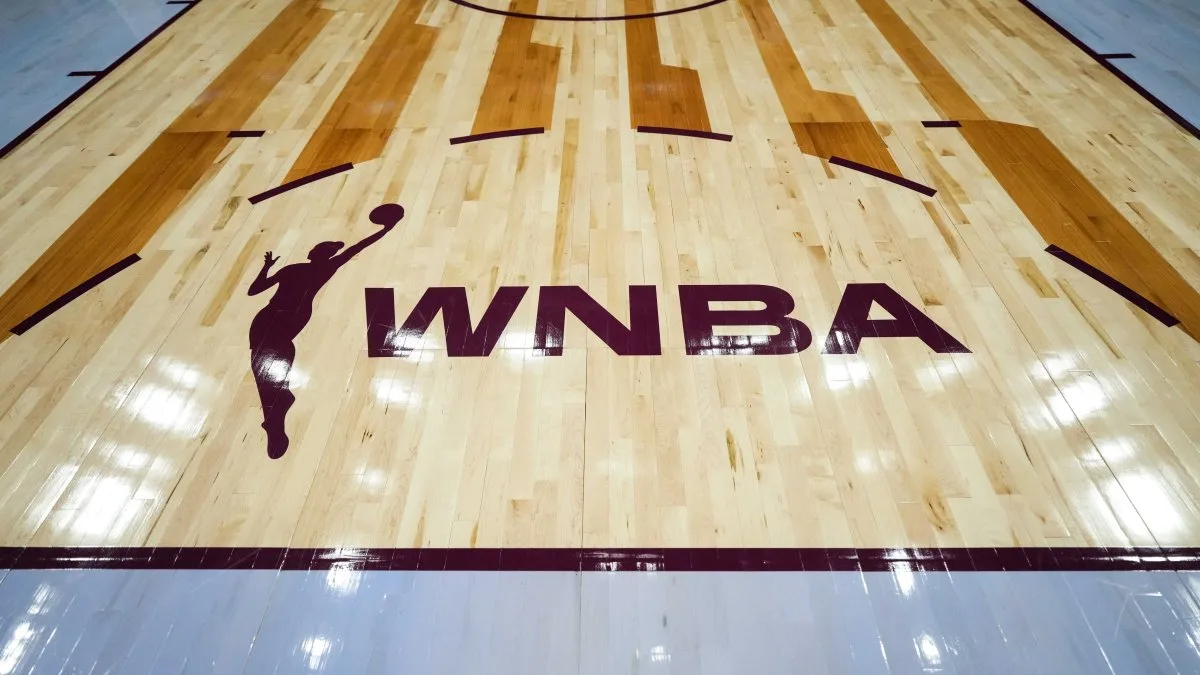
The 2026 WNBA rulebook does contain an instruction for players, coaches and trainers to stand in an orderly line during the national anthem. That printed instruction is only part of the current discussion. The Associated Press has reported that the league suspended anthem protocols in 2017, and a team's absence from the floor does not, by itself, explain its instructions, its players' motives or an automatic penalty.
What the 2026 WNBA rulebook actually says
The most useful starting point is the current document, rather than a screenshot from an unspecified year. The WNBA's official rules page links the 2026 edition. Its Comments on the Rules section includes an anthem provision under player and team conduct and dress. A claim that the league has never printed an anthem instruction is therefore inaccurate.
The instruction appears in Comments on the Rules
Paragraph H(2) identifies players, coaches and trainers and directs them to stand in a dignified line along the sidelines or foul line while the anthem is played. The sentence concerns posture and arrangement. It does not, in that same sentence, instruct everyone to sing, prescribe a hand-over-heart gesture or announce a specific fine for every possible departure from the arrangement.
That location matters when someone shares an isolated quotation. It is a conduct instruction in the league's published rules, not a description of a live-ball foul on a possession. It also identifies team personnel, rather than establishing an arena-wide rule for every spectator, employee and performer. Before applying a sentence to a particular person, check whom it actually names.
Reading the text carefully does not settle the separate issue of how the league administers it today. Published language, later directions to clubs and actual enforcement can be different parts of the record. A reliable explanation needs to account for all three instead of using the existence of one document to declare the others irrelevant.
Presence and posture are different questions
A team remaining in its locker room and a player standing on the floor in a different posture are not identical observations. To evaluate either, you need the applicable directions and the sequence of events. A photograph of an empty sideline establishes who was visible at that instant. It does not reveal every instruction supplied to the team before the game.
In its October reporting, the Associated Press account carried by NBC noted uncertainty about whether the printed language addressed personnel already on the court or entire teams. That uncertainty should remain visible in an explanation. It should not be silently resolved by adding words to the rule or announcing a definitive interpretation the league has not supplied.
The careful answer is therefore specific: there is written anthem language, and its present implementation requires more context than the sentence alone supplies. That answer allows fans to discuss whether the policy should be clearer while keeping a preference about policy separate from a verified account of what currently governs a team's routine.
Why the reported 2017 protocol suspension matters
The Associated Press reported that a late-2017 memo suspended the league's anthem protocols following the violence in Charlottesville, Virginia. That account is important context for claims based only on the printed rule. A suspension of protocols and the removal of language from a published rulebook are different changes; the current book still contains the instruction.
Those are different forms of evidence. A current rulebook lets a reader inspect the published wording directly. A report about a memo tells the reader what a news organization learned about another document. Both can matter, but neither should be mislabeled. Describing the memo as reported is more accurate than announcing that the rule was formally deleted from every subsequent edition.
The league's own 2020 statement about Breonna Taylor supplies separate historical context: the WNBA described that season's focus on systemic racism and police brutality. That statement establishes the league's public position in that season. It is not, on its own, a complete set of anthem instructions for a 2026 Finals game. The two documents answer different questions.
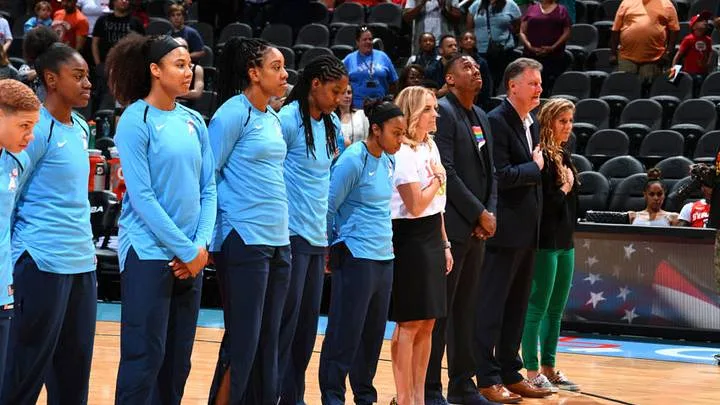
Chronology is essential when discussing a long-running practice. A photograph from 2019 cannot establish what a team was told in 2026. An explanation of 2020 cannot automatically identify the reason every present player follows a routine. A recent clip can show what happened at one game without showing when that routine began. Keep the dates attached when comparing those pieces.
For the broader sequence of league developments, our WNBA history timeline provides background. For the anthem question itself, the unresolved item is more specific: a clear, current statement explaining how the published instruction interacts with the reported suspension and teams' present pregame arrangements.
A fan can reasonably want that clarification without treating its absence as proof of misconduct. Conversely, acknowledging the reported suspension does not require pretending that the printed instruction disappeared. Holding both facts in view is the most useful way to explain why people reading different sources can reach very different initial impressions.
What a team's pregame routine can and cannot tell you
The October discussion arose because Atlanta and Golden State were not on the floor for the anthem during the Finals. AP reported that Golden State described an existing routine dating to its first season and that Atlanta had followed an off-court routine for several years. That is important context for a suggestion that the Finals suddenly produced a new action.
It is still necessary to distinguish what a team says from what a viewer infers. Calling something a routine describes a repeated sequence. It does not automatically explain every reason behind the original choice, establish that every team uses it or resolve the league's policy. A useful account can report the stated routine without filling those gaps with a preferred explanation.
A team decision is not an explanation of every player's beliefs
A group following one pregame schedule does not provide a reliable survey of each person's opinions. Individual players can have different reasons for taking part in the same preparation. Without an attributable statement, assigning one political motive to every visible or absent player goes beyond what the observation establishes.
The opposite inference is also too strong. Saying a team has an established routine does not prove that no participant attaches personal meaning to it. The available evidence may simply be insufficient to answer the individual question. That is a narrower and more accurate conclusion than either declaring universal agreement or declaring that nobody involved cares about the anthem.
Consider a hypothetical team that leaves the floor before a ceremony, returns for introductions and then begins the game. A clip of the departure can establish a movement. A coach's account can explain the team's schedule. A player's own statement can explain that player's reason. Those are complementary pieces of information, rather than interchangeable proof of the same claim.
Broadcast timing can hide part of the sequence
A short broadcast segment may begin after a team has already left the floor or end before its return. A camera focused on the singer cannot necessarily show every team member's location. Before calling footage a complete record of the pregame, check what period it actually covers and whether the same sequence is visible for both teams.
This is a viewing caution, not an allegation that a particular network concealed anything. Every production chooses shots and segments. The fact that a viewer did not see an event in a selected clip does not establish that it did not occur elsewhere in the arena or outside that clip's time window. Likewise, an empty bench does not disclose what people were doing off camera.
The WNBA TV schedule identifies game coverage, but a listed telecast should not be read as a promise that every pregame ceremony will be shown in full. If the ceremony itself is the subject of a claim, look for a continuous dated recording and a direct explanation from the relevant team. Keep that evidence separate from a highlight designed to summarize the basketball.
Why an anthem absence does not establish an automatic penalty
There are several steps between observing an absence and accurately reporting a sanction. First establish what happened at the game. Next identify the directions that applied to that team. Then identify the authority responsible for a decision and any actual action it announced. Skipping those steps can turn a disagreement about how a policy should work into an unsupported report about what the league has done.
The anthem paragraph does not attach a specific automatic punishment to every possible absence. That does not prove the league lacks any authority over team conduct. It means a claim about a particular fine, suspension or game penalty needs its own support. A number copied from another sport, a different rule or an unrelated disciplinary incident is not enough.
A useful comparison is the difference between a demand and a decision. A commentator can call for a fine. A fan can argue that a rule should be enforced more consistently. Neither statement establishes that the WNBA imposed a fine, determined a violation or privately instructed a club to change its preparation. Label each statement according to what it actually is.
Silence also has limits as evidence. An unanswered question does not automatically confirm the questioner's interpretation. It does not establish the opposite interpretation either. As of October 27, the publicly available account still leaves questions about the relationship between the printed instruction and the reported suspension. Neither a newly announced penalty nor a new league interpretation should be assumed from that uncertainty.
Spectator policy belongs in a separate discussion. The league's Fan Code of Conduct addresses the arena environment and fans' behavior. It should not be substituted for the instructions governing team personnel. Likewise, our account of the Fever-Dream shirt incident concerns a different set of people and decisions. It is not an anthem precedent simply because both stories involve expression at a basketball game.
Keeping those boundaries clear permits a more precise criticism or defense of the policy. You can ask the league to explain its current expectations, request the operative protocol or discuss whether the written language should change. Those are concrete questions. They do not require announcing that an unseen instruction or an unreported punishment already exists.
How to assess the next anthem claim
Start by identifying exactly which claim is being made. "The rulebook contains a standing instruction" and "the league imposed a penalty last night" are not two versions of the same statement. The first can be checked against H(2). The second requires an actual disciplinary announcement. A third claim, about a team's reason for staying inside, calls for an explanation from that team or an identified participant.
| Question | Useful source | What it does not settle alone |
|---|---|---|
| What is printed? | The current WNBA rulebook | Every later instruction to teams |
| Was this a new routine? | A dated team explanation and earlier game records | Every individual's personal reason |
| Did the WNBA change its directions? | A current league statement or operative protocol | A change merely advocated by a commentator |
| Was someone punished? | A specific league disciplinary decision | A punishment someone thinks should happen |
The dates provide a quick second check. The 2017 suspension report, the league's 2020 social-justice activity and the 2026 Finals discussion describe different moments. A headline that merges them into one newly announced policy needs closer reading. A source identifying a longstanding routine can correct the timing of a claim even when it leaves the original reason for that routine unanswered.
For Atlanta and Golden State, also distinguish team personnel from spectators and the anthem performer. A singer continuing the ceremony while players prepare elsewhere does not tell you what every member of the audience was instructed to do. A crowd reaction does not establish a player policy. These are separate participants in the same arena, with different roles and potentially different instructions.
WNBA games and international tournaments use different procedures
It is possible to see the same athlete on the court for an international anthem ceremony and off the floor during a WNBA pregame. Those settings are administered by different organizations and have different presentation schedules. AP's account noted that national-team ceremonies at the World Cup and Olympics involve both countries' anthems after lineup introductions. That comparison supplies context; it does not turn a WNBA paragraph into an international regulation.
If an international event is the subject of a dispute, look for that event's regulations and instructions. Do not infer an identical timeline simply because both games use a basketball court. Likewise, an athlete following the prescribed sequence in one competition does not, without further explanation, resolve why a different team uses another sequence elsewhere.
For an upcoming WNBA game, consult the current game listing for the matchup, then use team or arena communications for any published pregame arrangements. A game time establishes when to plan your viewing; it does not guarantee that a ceremony will be included in every stream or that one team's routine applies to its opponent.
The concrete questions remain manageable: what does H(2) say, what current directions govern the team, what actually happened, and what explanation or decision followed? Those questions leave room for disagreement about the preferred policy while keeping the account of the existing situation accurate.
Sign in with Google to join the discussion.