

A WNBA reset timeout is a separate late-game resource that can let a team advance the ball under the normal advancement rules and make substitutions without holding a huddle. Having no regular team timeouts left does not, by itself, mean the team has no reset. The distinction became central to New York's October 7, 2026, semifinal loss to Atlanta.
What the WNBA concluded about the Liberty-Dream dispute
The Dream won Game 2, 101-98 in overtime. The Liberty did not use an available reset before their final attempt, and Breanna Stewart said afterward that she had asked officials about it. The early accounts conflicted. The important follow-up came on October 9, after the league reviewed video, audio and information from the people involved.
In the league statement reproduced in Yahoo Sports' investigation follow-up, the WNBA confirmed that Stewart asked referee Kevin Fahy about the reset. It attributed the episode to overlapping conversations and nonverbal exchanges that produced a misunderstanding. The league also said officials received feedback about handling such interactions and that it did not expect further follow-up at that time.
That conclusion matters because an explanation stopping at the initial postgame dispute is incomplete. It also has limits. The final statement did not establish every word each person heard, declare that someone intentionally misled Stewart or demonstrate what the Liberty would have scored if they had used the reset. Those stronger claims should not be substituted for the finding actually issued.
Four questions need to stay separate: did the team have the resource, did a player ask about it, did someone make a valid request to stop play and what could the resulting possession have produced? Knowing the first answer does not automatically settle the other three. That is why understanding the rule is more useful than reducing the incident to one disputed gesture.
The rule explanation below uses the 2026 WNBA rulebook, checked on October 27. It distinguishes the reset from a regular timeout and explains the request procedure. The broader background on 2026 officiating addresses league-wide concerns; this guide focuses on the specific late-game resource involved in the Liberty-Dream episode.
What a reset timeout actually allows
The reset is designed for a brief interruption rather than a full coaching conference. Under Rule 5 of the 2026 WNBA rulebook, it shares ordinary timeout characteristics except where the reset provisions specify differences. The most useful effects are the option to advance an eligible possession and the opportunity to change players.
Those benefits should not be confused with guaranteed possession, an extra shot or a new clock. The team must first be entitled to request the stoppage, and the subsequent throw-in follows the applicable rules. A reset cannot retrieve a ball that has already become the opponent's possession simply because the original offense wants another chance.
Advancing the ball depends on the normal advancement conditions
The reset section refers to the ordinary late-game advancement rule. That rule allows an eligible offensive team to choose a frontcourt throw-in at the designated hash mark rather than the otherwise applicable backcourt location. The circumstances of the possession matter, including whether the ball was out of bounds or had just been secured in the backcourt before being advanced.
For example, a team obtaining a backcourt rebound can have an advancement option if it calls the appropriate timeout before advancing the ball. Once the ball has been thrown in, dribbled or passed, the rule contains additional restrictions. It is therefore inaccurate to say that any reset, requested anywhere during the final minutes, automatically transports the ball to the frontcourt.
In a close finish, advancing can reduce the distance between the inbound location and a potential shot. It does not decide which pass is available, whether the defense will switch or whether the shooter will make the attempt. The strategic opportunity is meaningful without being equivalent to an awarded basket.
Substitutions are allowed, but the shot clock does not restart
Both teams may make unlimited legal substitutions during a reset. A coach can adjust the lineup for the next possession, and the opponent can also respond within the substitution rules. The term legal still matters: the reset is not permission to ignore normal player eligibility or substitution administration.
The shot clock remains where it was when play stopped for the reset. The name does not mean that the offense receives a fresh 24 seconds. Viewers should distinguish resetting the location or personnel from resetting a timing device. If another rule separately affects the clock, that must be identified on its own.
This is particularly important when only a few seconds remain in the game. A team may improve its inbound location while retaining very little time to release a shot. The reset changes the starting conditions of the possession; it does not remove the urgency that made the stoppage valuable.
When teams receive a reset in regulation and overtime
Each team is entitled to one reset in the final two minutes of the fourth quarter and one in the final two minutes of each overtime period. The reset is separate from the ordinary team-timeout allocation. That is why a graphic showing zero regular timeouts does not necessarily mean that no useful late-game stoppage remains.
| Resource | 2026 allocation | Important timing limit |
|---|---|---|
| Regular team timeouts in regulation | Five, subject to the rulebook's late-game limits | The fourth-quarter restrictions still apply. |
| Regular team timeouts in an overtime | Two | May be called during that overtime when a valid timeout request is permitted. |
| Reset in the fourth quarter | One | Available only in the final two minutes. |
| Reset in each overtime | One | Available only in that overtime's final two minutes. |
The distinction also prevents the reverse mistake. Possessing a reset does not authorize its use early in the third quarter or at any convenient point in overtime. A team with three minutes left in an overtime has not yet entered the reset window, even though it will have that resource available later if unused.
Unused resets do not carry into the next period
A team cannot bank an unused fourth-quarter reset and add it to the overtime entitlement. Nor can it save a reset from the first overtime to have two in the second. The rule explicitly prevents carryover. Each new overtime has its own reset window and resource.
Conversely, using the fourth-quarter reset does not consume the reset for a later overtime. Imagine a team advancing an eligible possession with a reset in the final minute of regulation, then reaching overtime. It can still have the separate overtime reset when that period enters its final two minutes.
For viewers reconstructing a close finish, start with the period rather than the game's entire timeout history. Ask which resource was used in that period and which remains now. Simply counting every timeout gesture since the opening tip will mix different allocations and can produce the wrong conclusion.
How a player or coach requests a reset
The rule specifies a combined procedure. The head coach or a player calls a timeout, then immediately makes an X with the arms and says that it is a reset. The visual and verbal elements identify which resource the team is requesting. If the team fails to follow the procedure, an ordinary team timeout may be charged.
The underlying opportunity to call a timeout still matters. A request is generally granted when the ball is dead or controlled by a player on the requesting team. A reset does not let a defender stop an opponent's live possession whenever the clock enters the final two minutes.
For a simple hypothetical example, an eligible team preparing a backcourt throw-in can request the reset, identify it clearly and then receive the applicable advancement option. A player losing control of a live ball cannot assume that saying reset afterward retrieves possession. The timing of the request and the officials' recognition are important parts of the sequence.
Asking about availability is different from requesting the stoppage
Asking an official whether a reset remains is a request for information. Calling for the reset through the prescribed procedure is a request to stop play and charge the resource. The first can influence the second, but they should not be treated as identical events.
That distinction helps explain why the Liberty episode involved more than reading a timeout counter. The final league review confirmed that Stewart asked about the resource. It did not supply a complete public transcript establishing what every participant understood or resolve every hypothetical decision that might have followed clearer communication.
A practical sequence for a team is to know its resources, identify the intended stoppage clearly and verify the completed administration. For a viewer, the corresponding task is to watch the recognized signal and the resource charged. A brief gesture seen on a distant camera may show that a conversation occurred without proving exactly what was asked or granted.
The risk of confusion is also why a reset is not an informal favor from the crew. It is a defined resource with a window, a remaining count and a request procedure. Understanding those elements provides a firmer basis for evaluating an incident than assuming any conversation near a referee automatically stopped the game.
Why a reset is not a free coaching timeout
The reset's no-huddle restriction is central to its design. Either team can receive a delay-of-game ruling for huddling or preventing the ball from being put back into play immediately. Teams can substitute, but they are not entitled to turn the stoppage into an ordinary bench conference.
A photograph of a normal coaching discussion illustrates the contrast. Those familiar moments are part of basketball, but the reset is deliberately more limited:
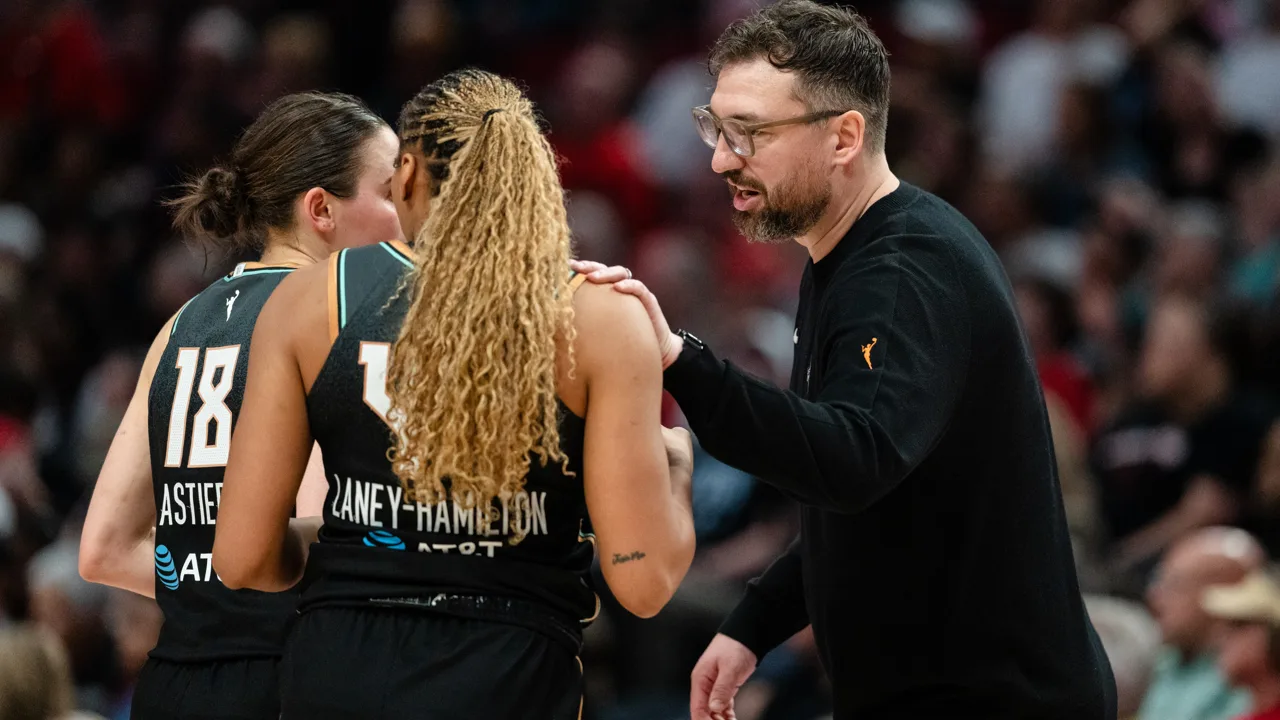
The rule also limits using a reset for an injury stoppage or another delay when the team still has regular team timeouts available. That prevents the short resource from becoming a general replacement for the ordinary timeout structure. It should be evaluated according to the actual reason for the stoppage and the resources remaining.
Requesting a reset that has already been used, or requesting it outside the permitted window, can instead cost a team timeout. If no team timeouts remain, an invalid request can become an excessive timeout. That is different from a valid reset remaining after the ordinary timeouts have been exhausted.
Consider a hypothetical team with no regular timeouts and an unused reset during the final minute of overtime. The absence of ordinary timeouts does not automatically make a properly requested reset excessive. Change the example so that the reset was already used, and the resource situation is different. The word reset alone does not protect an invalid request.
This distinction explains why players and coaches want certainty before requesting a stoppage in a tight game. It does not establish that any particular person deliberately withheld information in the Liberty incident. The league's completed finding was a communication misunderstanding, and the rule analysis should not be used to invent a stronger disciplinary conclusion.
How to read the next late-game timeout situation
The most useful way to follow a disputed finish is to reconstruct the sequence rather than start with a conclusion about who must be at fault. Identify the quarter or overtime, the time remaining, the team's ordinary timeouts and its reset status. Then separate the request from the ruling and the outcome of the next possession.
A score graphic is useful but does not explain every exchange
A broadcast timeout indicator can alert viewers to an available resource. It cannot tell you everything said between a player, a referee, a bench and the scorer's table. Nor does the presence of an indicator establish that a valid request was made, heard and administered at a particular moment.
The Liberty case showed why later information matters. Initial accounts left an apparent conflict; the league's subsequent review confirmed an inquiry and described a misunderstanding. Reposting only the earliest clip can omit the most important development. A careful explanation should identify the date of the account and whether the investigation had finished.
That standard works in both directions. A later statement should not be expanded into conclusions it did not reach. Confirmation that a player asked a question is meaningful, but it does not establish intentional wrongdoing or guarantee a different final score. Keep the finding and its limits together.
Check the period, remaining resource and completed ruling
Three hypothetical checks resolve many common misunderstandings. A team that used its fourth-quarter reset can still have the separate reset in overtime. A team with no ordinary timeouts can still make a valid reset request if that reset remains available within its window. A team with an unused reset cannot use it before the final two minutes simply because a possession feels important.
After a valid reset, look for the inbound location, any substitutions and the remaining clocks. Do not expect a huddle or a fresh shot clock. If the request is invalid, follow which resource the officials charge rather than assuming every stoppage has the same cost.
The discussion of a 2027 replay center concerns a separate future officiating development. It does not rewrite the 2026 reset rule or turn every communication dispute into a replay challenge. The resource described here comes from the current timeout structure.
For the next broadcast, use today's WNBA games and the WNBA TV schedule for the current matchup and viewing window. During the final minutes, the clearest checklist is period, resource, request and ruling. That makes the strategy easier to follow without assuming that a disputed timeout explains every part of a close game's result.
Sign in with Google to join the discussion.