
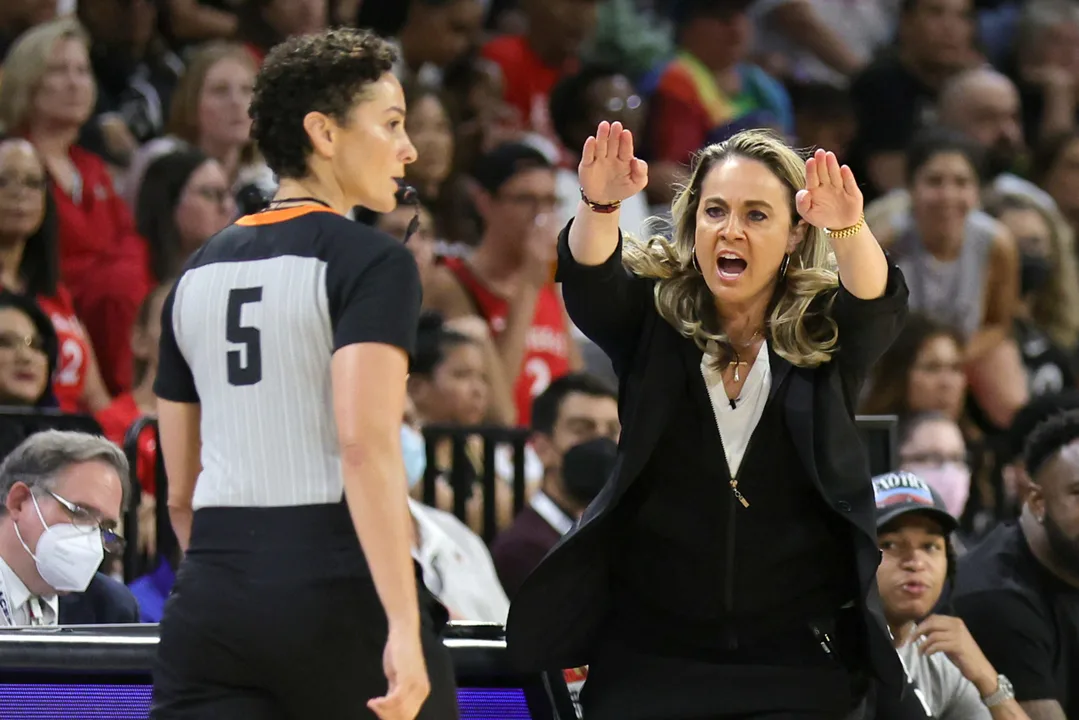
How are a technical foul, an ejection and a suspension different?
A WNBA technical foul is a penalty assessed in connection with a game. An ejection removes a participant from that game. A suspension prevents participation in another game or games under the applicable league decision or accumulation rule. The three can be related, but one does not automatically establish the others.
A player can receive one technical and remain in the game. A serious act can also require an ejection without waiting for two ordinary conduct technicals. Separately, the league can review an incident and decide whether further discipline is warranted. That is why a technical on the score sheet and no later suspension can coexist.
| Consequence | The question it answers |
|---|---|
| Technical foul | What game penalty was assessed, and in which category? |
| Ejection | Was the participant removed from the current game? |
| Suspension | Is the person barred from another game or games? |
| Fine | Was a financial penalty imposed under the applicable rules or decision? |
A fine is another separate consequence. It should not be assumed to exist only when someone is suspended, nor should a report about no additional league fine be rewritten as a statement that no technical foul occurred. The exact action described in a report matters.
The 2026 WNBA rulebook is the foundation for the distinctions below. This guide was checked on October 27, 2026 and uses the current season's accumulation thresholds. Older articles can describe different limits or fine amounts, so their year should be checked before using them to predict a penalty.
Our 2026 officiating changes guide covers the wider discussion about enforcement. Here the focus is how to read an individual incident: identify the foul, determine whether a removal rule applies and then look separately for the league's later decision. A disagreement about one stage does not answer every other stage automatically.
What a technical foul does during a game
The word technical covers more than arguments with referees. Before counting toward an ejection or speculating about discipline, establish which category was assessed and who was charged. A team penalty and an individual's unsportsmanlike conduct are not interchangeable descriptions.
Conduct penalties and procedural technicals are not identical
Rule 12A permits a technical for conduct that an official considers detrimental to the game, and it does not require a warning first. The rule gives examples of unsportsmanlike behavior, including disrespect toward an official, overt resentment of a call and taunting. Those examples help explain why a conduct technical can occur without a new basketball foul against an opponent.
Other technicals concern how the game is administered. Defensive three-seconds, certain delay-of-game situations and specified basket-ring violations are among categories the rulebook distinguishes from unsportsmanlike acts. A technical of that kind does not, by itself, establish that the player was abusive or confrontational.
Even the immediate scoring consequence needs its category. An ordinary single technical generally awards a free-throw attempt, while double technicals do not produce those attempts. It is also unsafe to assume that every technical automatically transfers possession in the same way. The applicable provision controls the restart.
For a viewer, that means a broadcast graphic showing T is only the beginning of the explanation. Listen for whether the call concerns individual conduct, a team procedure or another defined violation. The label determines which later comparisons are meaningful.
Two unsportsmanlike technicals can end a player's game
The conduct rule requires ejection for two unsportsmanlike acts. It also allows an offender to be ejected for a single unsportsmanlike act. Two is therefore a mandatory removal point for that category, not a promise that every participant receives one consequence-free warning.
Consider a hypothetical player involved in a defensive three-seconds technical and, later, a dissent technical. Those events should not be casually rewritten as two unsportsmanlike acts just because both involved a technical penalty. A proper assessment needs the classifications, not merely two appearances of the letter T.
Conversely, a participant who commits a sufficiently serious act cannot assume that having no earlier technical protects her from removal. The reason for the sanction matters. Counting only previous technicals can miss a rule that applies immediately to the incident in front of the officials.
This distinction also helps when reviewing a box score afterward. The statistical record, the play-by-play description and the officials' explanation can answer different parts of the question. Use them together before claiming that a player necessarily should have remained or necessarily should have been removed.
When one incident can lead to an immediate ejection
Not every removal decision depends on a two-technical count. Some acts have their own mandatory ejection provisions. The correct question is whether the actual incident satisfies one of those provisions, rather than whether the participant already had a technical earlier in the night.
Serious acts have their own removal rules
The current rulebook lists punching and fighting among acts requiring removal. It also requires ejection for a Flagrant 2 and for a second Flagrant 1. The distinction between those flagrant categories matters: a single Flagrant 1 does not become a Flagrant 2 simply because the contact looked upsetting to a viewer.
Other listed acts include a defined attempted punch or swing without contact and forcefully throwing or kicking the ball into the stands. Such rules explain why the absence of a landed punch or an earlier conduct technical does not always settle the removal question.
Those immediate rules still do not make the future disciplinary outcome identical in every case. The rulebook separately addresses league fines and suspensions. An ejection tells the viewer that the person's participation in the current game has ended; a later announcement is needed to understand an additional league sanction.
The spectator stands are different from the court area
The spectator provision is especially relevant when a clip shows someone near courtside seats. The rulebook requires automatic ejection for deliberately entering the spectator stands during the game and identifies the first row of seats as the beginning of the stands. It also distinguishes that conduct from going there as part of continuing play or being carried there by momentum.
Crossing the painted boundary of the playing floor does not, by itself, establish every element of deliberate entry into the stands. A player can be outside the lines while still in the surrounding court area. Establishing where the player went is therefore essential before invoking the rule's mandatory consequence.
A hypothetical save attempt illustrates the other distinction. A player chasing a live ball whose momentum carries her toward seats is not automatically committing deliberate spectator entry. A separate intentional movement into the seating area for a confrontation presents a different factual question. The labels should follow what happened, rather than replace the evidence.
A still photograph or an emphatic social-media caption can omit those details. Use the broader sequence, the arena layout and the official explanation when available. That approach permits a reader to discuss the rule without first assuming that a particular disputed incident met its conditions.
How technical-foul accumulation affects later games
Season accumulation is another system entirely. It tracks qualifying technical assessments across games rather than asking only what happened in one contest. A player can therefore finish the game in which an accumulation threshold is reached and still face a suspension affecting a later game.
The 2026 regular-season threshold is eight
The 2026 disciplinary schedule reported by Front Office Sports places the regular-season one-game suspension at the eighth technical. Further one-game suspensions occur for every two additional technicals, such as the tenth and twelfth. Older seven-technical summaries should not be carried into this season.
The article also describes escalating fine amounts. That financial schedule is separate from the two-unsportsmanlike-acts rule within one game. Paying attention to which count is being discussed prevents a common mix-up: treating the season's eighth assessment as though it must also be the player's second assessment that night.
Rescissions can change the practical answer. AP's August 28, 2026 report confirmed that Angel Reese's eighth technical was rescinded and that she remained available for the following game. The initial call and the final standing assessment were therefore different records.
That example is useful without turning this article into a changing leaderboard of technical totals. Before predicting a particular player's availability, check whether the disputed assessment still stands and whether the league has announced the game in which any suspension will be served. A graphic captured during the game can become outdated.
The playoffs use a separate count and threshold
The reported 2026 playoff structure resets the technical count after the regular season and places the first accumulation suspension at the fourth playoff technical. The later every-other-technical pattern likewise differs from treating each postseason technical as an immediate suspension.
A reset of the count should not be confused with erasing an already imposed penalty. Those are different administrative questions: which assessments count toward a new threshold, and when an existing suspension must be served. Read a league notice about the actual sanction rather than infer the second answer from the word reset.
A hypothetical player receiving one qualifying technical in each of four playoff games illustrates the difference. The player need not have received two unsportsmanlike technicals in any one of those games for the accumulation consequence to become relevant. Conversely, two unsportsmanlike acts in one game can require removal long before four playoff technicals have accumulated.
Our WNBA playoff format guide explains the competition stages. For discipline, identify the phase, the applicable count and the latest standing decision before interpreting what the next scheduled game means for an individual participant.
What was confirmed after A'ja Wilson's fan incident
Wilson received a technical during the September 29, 2026 Aces-Fever playoff game and was not ejected. Subsequent reporting on October 1 said the WNBA would not impose an additional fine or suspension for the incident. Those are separate facts about the in-game assessment and the later disciplinary outcome.
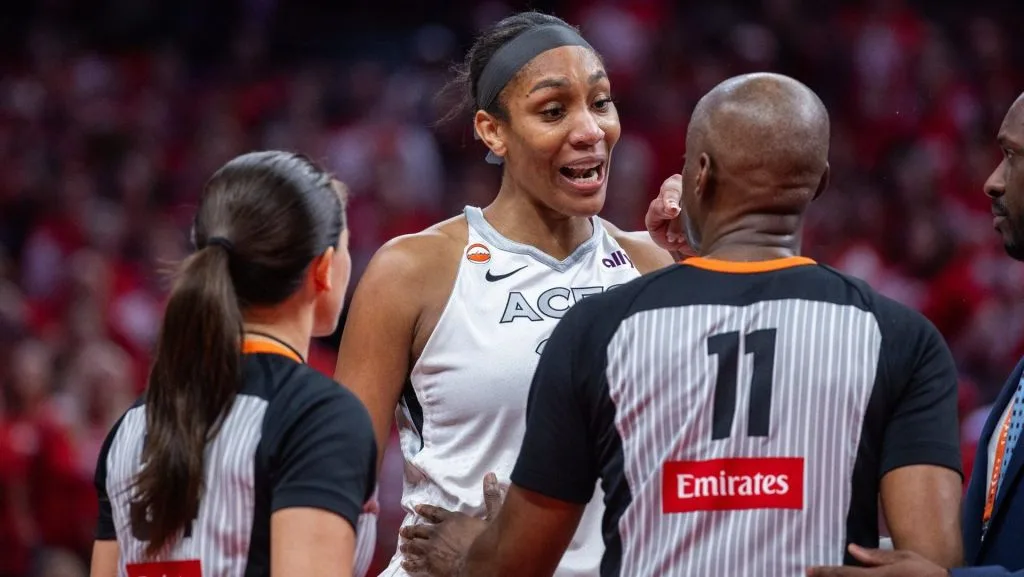
The Associated Press report carried by FOX5 attributed the review explanation to a person familiar with the ruling. That account said officials determined Wilson had remained within the court area. It also reported that the spectator returned to the seat after being found not to have violated the Fan Code of Conduct.
Front Office Sports separately cited a league source describing the location as the player escape lane beside the stanchion rather than the stands. Its report also identified the assessed technical as unsportsmanlike conduct, citing the crew chief's pool-report explanation.
That distinction connects directly to the rulebook. The mandatory spectator-entry provision depends on entering the stands; crossing a playing-floor boundary alone does not establish that finding. At the same time, remaining in the court area does not mean that no conduct technical can be assessed. The two questions use different conditions.
Readers should preserve the limits of the reporting. The October 1 explanations were attributed to sources, not a public transcript establishing every word spoken. They do not support inventing an abusive remark, a threat or a fan's motive. Earlier captions or commentary describing entry into the stands should not override the later reported review finding.
Nor does no additional discipline mean that the original technical disappeared. It means the later review did not produce the extra sanction being discussed. Keeping the original assessment, the removal question and the league follow-up separate gives a more accurate account than treating the event as one all-or-nothing decision.
How to follow a disputed call without mixing the penalties
A disagreement is easier to assess when the question is stated precisely. Was the technical itself justified? Did a mandatory ejection provision apply? Did the participant reach an accumulation threshold? Did the league later add, remove or decline a sanction? Each question requires a different part of the record.
Check the assessed foul, the removal and the later league decision
Begin with the assessed event and the person charged. Then look for the officials' explanation, especially if the conduct category is unclear. A description of a team procedural violation should not silently become an accusation of individual misconduct.
- Identify the exact foul category and the participant or team charged.
- Establish whether the removal question concerns two unsportsmanlike acts or a separate immediate-ejection rule.
- For accumulation, check the competition phase and the latest standing total.
- Look for a rescission or a later disciplinary notice before predicting availability.
- Retain dates and attribution when a report relies on a source familiar with a review rather than a public league release.
Also separate a coach's challenge from other review processes. Rule 14 does not make technical or flagrant rulings independent challengeable events. That does not eliminate the officials' other defined replay powers or the league's ability to review conduct afterward. Asking why a coach did not challenge a technical can therefore begin from the wrong assumption.
The planned centralized replay operation is another distinct topic. Our 2027 WNBA Replay Center explanation addresses the future system. Its announcement does not mean every 2026 decision was already handled there, nor does a new facility automatically change which events are eligible for a particular review mechanism.
Finally, distinguish a rule interpretation from a claim about someone's behavior. It is possible to explain the spectator-entry rule without asserting that an unverified insult occurred. It is possible to question a technical without claiming that every later sanction was mandatory. A dated, specific account gives readers something they can compare against the actual record, while leaving room for a documented correction when the league changes an assessment.
Sign in with Google to join the discussion.